The Allied invasion of Sicily, also known as the Battle of Sicily or Operation Husky, was a major campaign of World War II in which the Allied forces invaded the island of Sicily in July 1943 and took it from the Axis powers (Fascist Italy and Nazi Germany). It began with a large amphibious and airborne operation, followed by a six-week land campaign.
Tomorrow marks the beginning of the invasion.
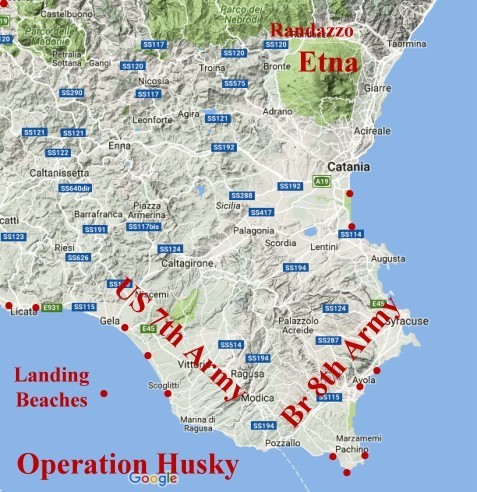
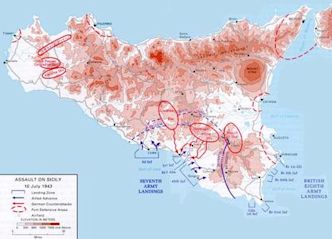
To divert some of the Axis forces to other areas, the Allies engaged in several deception operations. Husky began on the night of 9–10 July 1943 and ended on 17 August. Strategically, Husky achieved the goals set out for it by Allied planners; the Allies drove Axis air, land and naval forces from the island and the Mediterranean Sea lanes were opened for Allied merchant ships for the first time since 1941. These events led to the Italian leader, Benito Mussolini, being toppled from power in Italy on 25 July, and to the Allied invasion of Italy on 3 September.
Strategic Implications
The German leader, Adolf Hitler, “canceled a major offensive at Kursk after only a week, in part to divert forces to Italy,” resulting in a reduction of German strength on the Eastern Front. The collapse of Italy necessitated German troops replacing the Italians in Italy and to a lesser extent the Balkans,
resulting in one-fifth of the entire German army being diverted from the east to southern Europe, a proportion that would remain until near the end of the war. Secondly, without Sicily it is unlikely that Normandy almost a year later would have been possible. The lessons learned about large combined arms operations in Sicily provided great aid to the allied planners and warriors. Many who fought in Sicily went on to the beaches of France.
 Bruce B.G. Clarke