In the summer of 1942, the 505th Parachute Infantry Regiment (PIR) was activated in the tarpaper shack Frying Pan area of Fort Benning, overlooking Lawson Army Airfield. (23 years later his son’s first assignement–Jump School would have him living there in a Bachelor Officer’s (BOQ.)) Art Gorham commanded the 1st Battalion. There was no time lost in getting a demanding training schedule started. According to his headquarters company commander of the time, Captain Walt Winton (later to retire as a Brigadier General and my godfather), Art sweated with the rest of the battalion. The regiment subsequently moved across the Chattahoochee River to the Alabama Parachute Training Area, where the beat went on.
Art was promoted to lieutenant colonel (abbreviated as LTC) in December 1942. At the time, he was one of the youngest lieutenant colonels in the Army.

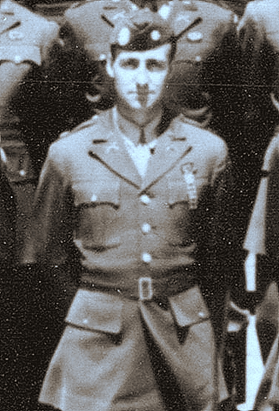
Lieutenant Colonel Arthur F. Gorham
Before the Regiment moved to Fort Bragg, North Carolina, LTC and Mrs. Gorham were joined by a son Bruce Bennett Gorham on January 26, 1943.

LTC Gorham holds young Bruce
When the 505th Parachute Infantry Regiment arrived at Fort Bragg, it joined the 82nd Airborne Division, commanded by Major General Mathew Ridgeway. Training at Fort Bragg evolved from teams and squads to platoons and companies and eventually as larger formations—part of the battalion, regimental and divisional team. The Regiment was to make the first regimental mass parachute jump when it jumped into Fort Jackson, South Carolina, under the watchful eyes of Sir Winston Churchill, Field Marshall Sir John Dill, and General George C. Marshall.

LTC and Mrs. Gorham’s quarters at Fort Bragg
After this mass jump at Fort Jackson, it was determined that the 82nd Airborne Division was better prepared for combat than the 101st Airborne Division. The Division was alerted for deployment overseas. During this time frame the Gorham’s opened their quarters to all of the married officers and their wives so that the couple could spend the last time before deployment together. (The post had been locked down and civilians could not enter it.) Many of these officers mentioned how wonderful such generosity was many years after the fact.
In mid-April 1943, the Division moved from Fort Bragg to Camp Edwards, Massachusetts, under a security blackout. Ten days later, the Division boarded the USS Monterey for the 12-day crossing of the Atlantic Ocean. The Division landed near Casablanca in North Africa. Subsequently, it moved to Oujda, French Morocco
 Bruce B.G. Clarke