Home » 2018 (Page 2)
Yearly Archives: 2018
Really?
Immediately after the President’s announcement that the US will withdraw from the Iran nuclear deal the liberal fake analyst pundits announced that the decision would undermine the negotiations with the North Koreans. This couldn’t be further from the truth.
In my recently published blog (the workup to the Korean Summit) I wrote: “The Trump Administration will most likely add into the Korean position its stand on Iran. The Iranian agreement does not provide the example that the Trump Administration wants the North Koreans to think is in the realm of the possible. It is sure to highlight the loopholes in the Iranian deal no matter how it decides to go forward.”
In other words the withdrawal will highlight to the North Koreans that they cannot get away with some fluffy document that has numerous loopholes and a lack of comprehensive verification of whatever is agreed to.
As the “we hate Trump pundits” look for something wrong with the withdrawal the North Koreans will have received several meaningful messages. The most important is that they must agree to a comprehensive denuclearization or they too can be isolated like Iran.
What are your thoughts?
The workup to the Korean Summit
Six months ago the common wisdom was that the United States and North Korea were on a collision course to armed intervention by the US and response by the North Koreans. Today as the Kim Jung Un and President Trump summit draws near there are some who are touting President Trump for the Nobel Peace Prize. How did we get here?
Some analysts believe that the North Korean change in direction is not the result of weakness, as many would have you believe. They argue that the North Koreans now perceive that they have demonstrated that they are valid members of the “nuclear club” and thus can come to a negotiating table in a position of strength. They have demonstrated nuclear weapons and ICBM technology. This capability can be redeployed in the future should an agreement fail. What is probably missing is reentry vehicle technology which is necessary to deliver a nuclear weapon. This with the construction of a new test facility can be mastered– the North Korean nuclear underground test site is collapsing.
On the negative side there is no doubt that the sanctions have hurt the North Koreans—especially since the Chinese have cooperated, somewhat in those embargoes. Given the nuclear standoff they have created there is no doubt that the North Koreans see an opportunity to greatly improve their economic situation. The question on the table is whether they will be willing to trade denuclearization for economic growth?
The North Koreans have played the fear of conflict in South Korea to improve their position vis-à-vis the US. The Olympic icebreaking followed by the recent Panmunjom north south summit with the announcement of the cessation of hostilities agreement was no doubt orchestrated to try and get the south to apply pressure, when/if needed to reach some form of agreement coming out of the upcoming meeting between Kim Jung Un and Donald Trump. The visit of President Moon of South Korea to the White House in coming weeks is no doubt focused on having a unified position going into summit.
There are also plans on the economic partial integration of the two Koreas that the South Koreans have created to increase the incentive for s for the North to agree to nuclearization. This is a two edged sword for the South Koreans. The South Koreans should talk to the Germans about the huge costs that they bore with the German unification.
Both sides have continued to move in jerks toward the historic meeting. The North has agreed to release 2 Americans being held in a labor camp so as to take that issue off of the table. The President has announced that 28,000 US forces stationed in Korea are not on the table. The North has complained of US rhetoric while promising to let experts and journalists visit the nuclear test site to verify its decommissioning.
Reaching an agreement on the denuclearization of North Korea will be a difficult negotiation. It will be difficult process to agree on the terms and their implementation. It is in this process that the Iranian nuclear deal sets a precedent. The Trump Administration will most likely add into the Korean position its stand on Iran. The Iranian agreement does not provide the example that the Trump Administration wants the North Koreans to think is in the realm of the possible. It is sure to highlight the loopholes in the Iranian deal no matter how it decides to go forward.
No one should expect a detailed agreement to come out of the upcoming summit. The best that could be hoped for is a broad agreement that:
- Codifies the denuclearization of North Korea
- Limits the development of ICBMs
- Provides for future technical negotiations with periodic reports of status to principals either individually or at subsequent summits for approval and further guidance.
- Links the relaxation of sanctions to progress on the limiting/eliminating of ICBMs and nuclear warheads.
Obviously verification protocols will be critical to the successful conclusion of this historic negotiation.
The upcoming summit is not an end in and of itself! It is a meeting to define and agree to a process that may take a year or more to conclude.
Images into multi-domain conflict
The Russians and Chinese have been giving us glimpses into their future weapon’s systems and their utilization. In considering these weapons utilization one can begin to see the ways that these two potential opponents envision fighting in future conflicts. One should also note that present conflicts are being used as testing grounds for these futuristic weapon systems.
The Russians have used Syria as a proving ground for their cyber and robotic capabilities. According to multiple Russian language blogs the Syrian Arab Army recently deployed ten Russian combat robots in a battle leading to about 70 rebel fighters and no Syrian casualties. Allegedly these robots were controlled from a Russian command post. (https://www.youtube.com/watch?v=9f5iWM5rLTY)
The Russians have demonstrated these robots and touted them in press videos as those noted above. Why? Most likely because the Russians are actually behind the American and Chinese in the development of robotic devices.
What is the motivation for robotic devices? There are many. In most cases robotic/remote controlled combat systems are cheaper to build and deploy since they are smaller and do not include the crew survival / protection measures and the associated weight and size that accompany crews. Such machines of war require fewer human warriors on the battlefield and thus reduce the entire human support costs.
Electronic warfare has been used on the battlefield since World War II. The commander of US forces in Syria recently reported that US AC130 gun ships were being jammed during support operations for the Syrian “rebels.” The electronic jamming signals affecting AC-130 gunships over Syria may have crews checking and cross-checking their data, including target information, before they lock on with their cannons, according to air commanders in Syria.
“Whether that’s being man-made, or maybe it’s a mistake inside the airplane, it’s hard to say sometimes, but the process is, as you see those things pop up, the safety for the people on the ground is the primary concern,” said Col. Tom Palenske, commander of the 1st Special Operations Wing…He continued: ““When you’re going to put lethal fires down on either enemy position or to protect friendlies, you’re concerned about the innocents around both our guys in uniform and civilians,” he said. “And when there’s some glitch being put out there by trons that threatens the accuracy of that, then the [AC-130 crews] have got to make sure they do no harm.”…Palenske did not say what kind of electronic warfare equipment adversaries are using, nor who the adversaries are, even though Islamic State fighters, Iranian-backed militia and Russian troops are in country.
Cyber warfare is coming and this is one of the first battlefield indications—the ability to take over a friendly fire control system. Hacking has become common place across military and civil society.
What is not being reported is the ability to work through or counter such spoofing and other types of cyber activities. There is also no public discussion of friendly use of similar capabilities.
Finally, The Chinese are reported to be using weapons grade lasers to engage US planes over Djibouti where there is a Chinese military installation. Currently the lasers are reported to be eye damaging. However the ability to target and engage a military aircraft with a laser portends a capability to do more than create eye damage with lasers. Future air defense weapons will most probably include radar directed lasers to destroy electronics and avionics in military aircraft. Presently, the lasers are likely denying US access to selected regions
The Chinese are also reported to have deployed air defense, electronic warfare and surface to surface missiles on three of their man made islands in the area claimed by the Philippines. These weapons threaten a significant amount of civilian naval traffic which could disrupt the economies of many of the nations in the area.
These new weapon deployments highlight the changing nature of warfare where new weapons can be used to achieve regional superiority for the accomplishment of a mission. This is the essence of the emerging US doctrine of cross domain operations.. (https://brucebgclarke.com/2017/07/12/multi-domain-warfare/)
If I were the devil
Many of my progressive friends have been castigating me recently for my conservative views. As a strategist I recently reread Paul Harvey’s remarks from 1965. I am posting them so that my progressive friends can give careful thought as to where we might be headed in their vision.
In 1965, Paul Harvey broadcasted “If I Were the Devil.” It is really amazing to realize over 53 years ago how accurately he “prophesied” the future spiritual condition of the United States. Many of his statements were considered ridiculously outlandish at that time in history. Yet, we find ourselves today…
.Paul Harvey’s “If I Were the Devil” Transcript from 1965
by Paul Harvey
If I were the devil … If I were the Prince of Darkness, I’d want to engulf the whole world in darkness. And I’d have a third of its real estate, and four-fifths of its population, but I wouldn’t be happy until I had seized the ripest apple on the tree — Thee. So I’d set about however necessary to take over the United States. I’d subvert the churches first — I’d begin with a campaign of whispers. With the wisdom of a serpent, I would whisper to you as I whispered to Eve: ‘Do as you please.’
“To the young, I would whisper that ‘The Bible is a myth.’ I would convince them that man created God instead of the other way around. I would confide that what’s bad is good, and what’s good is ‘square.’ And the old, I would teach to pray, after me, ‘Our Father, which art in Washington…’
“And then I’d get organized. I’d educate authors in how to make lurid literature exciting, so that anything else would appear dull and uninteresting. I’d threaten TV with dirtier movies and vice versa. I’d pedal narcotics to whom I could. I’d sell alcohol to ladies and gentlemen of distinction. I’d tranquilize the rest with pills.
“If I were the devil I’d soon have families that war with themselves, churches at war with themselves, and nations at war with themselves; until each in its turn was consumed. And with promises of higher ratings I’d have mesmerizing media fanning the flames. If I were the devil I would encourage schools to refine young intellects, but neglect to discipline emotions — just let those run wild, until before you knew it, you’d have to have drug sniffing dogs and metal detectors at every schoolhouse door.
“Within a decade I’d have prisons overflowing, I’d have judges promoting pornography — soon I could evict God from the courthouse, then from the schoolhouse, and then from the houses of Congress. And in His own churches I would substitute psychology for religion, and deify science. I would lure priests and pastors into misusing boys and girls, and church money. If I were the devil I’d make the symbols of Easter an egg and the symbol of Christmas a bottle.
“If I were the devil I’d take from those who have, and give to those who want until I had killed the incentive of the ambitious.
And what do you bet I could get whole states to promote gambling as the way to get rich? I would caution against extremes and hard work in Patriotism, in moral conduct. I would convince the young that marriage is old-fashioned, that swinging is more fun, that what you see on the TV is the way to be. And thus, I could undress you in public, and I could lure you into bed with diseases for which there is no cure. In other words, if I were the devil I’d just keep right on doing what he’s doing.
Paul Harvey, good day.”
Attack on Syria–Many Dimensions
As the Saturday morning quarterbacks seek to portray the coalition missile strikes in ways that support their own agendas it seems necessary to attempt to provide a multi-dimensional view on the strikes. These dimensions include:
· The military implications of the strike
· The diplomatic messages
· The domestic political reaction
In response to the Syrian attack on its own people using chlorine gas a coalition of British, French and American naval and air forces launched missile attacks against 3 chemical production and storage facilities. The objective of the attack was two fold:
1. Seriously degrade/reduce Syria’s chemical weapons capability
2. Deter Syria from future chemical weapon usage
Reports indicate that the missiles hit and severely damaged their targets. The ability and methodology used for the attacks indicate the ability to synchronize target engagement between multiple platforms and national assets. The US attacks came from naval forces in the Red Sea and the Mediterranean ocean. Air assets launched missiles while over Saudi Arabia and the Mediterranean. While launching the missiles each element of the attacking force took air defense, naval and cyber efforts to protect the force. Reportedly all missiles hit their targets while the Syrian missile defense efforts were an abysmal failure. The Syrians reportedly launched over 40 air defense missiles and none of them successfully engaged a target. (The Russian disinformation campaign reported that there were 103 missiles and 71 shot down.)
Militarily the mission was accomplished. However, some pundits are seeking to use this description of the reaction was to be expected as no matter what President Trump and our allies do there will be detractors who are looking for opportunities to speak against the President.
The diplomatic messages of this strike go far beyond the Syrian government. The clear pronouncement that the intent was not to target Syrian President Assad tells Kim Jung Un of North Korea that the US can accomplish its military objectives without necessarily threatening the regime leadership. (This is not to say that decapitation isn’t an option.) With the upcoming denuclearization discussions between President Trump and Kim Jun Un it is clear that Kim not necessarily feel personally threatened.
The preparations for the North Korea / United ‘States historic meeting are ongoing using multiple different avenues for the preparation of the meeting. Reportedly CIA Director/Secretary of State nominee Mike Pompeo is leading the back channel preparatory talks. The summit will follow a meeting between Pompeo and his North Korean counterpart.
Israel is touting the strikes as a message for Hezbollah and Hamas.
Russia is certainly evaluating President Trump’s resolve to not condone chemical weapon usage. The same is true for Iran as the May Iran nuclear agreement review approaches. John Bolton’s appointment as the National Security Advisor also tends to show an increased hardline by the administration on the major issues facing the United States. Certainly potential adversaries are viewing this whole set of events as a new entity.
The continuing fight against ISIS may have had an unintentional consequence. The net winner of ISIS’s destruction is clearly President Assad and his Russian and Iranian allies. The anti- Assad forces were not capable of filling the vacuum created by the damage to ISIS. The continuing conflict in the region is extremely complex given all of the players. This has been a subject of previous articles and one that we will return to in the future.
True to form the hard left politicians like Nancy Pelosi are condemning the attacks as uncivilized. This condemnation is to be expected. The other side of the aisle has been supportive the attacks. However, there seems to be a universal return to the discussion of the war fighting powers of the President. This is a continual power struggle between the executive and the legislature. This debate is probably more posturing than reality but may continue for several weeks and then return to its traditionally dormant status.
The attack against Syria may be the opening gambit in several future conflicts–Russia‘s desire to increase its posture in the Middle-East, Iran’s goal of forming a Caliphate across the region and its conflict with the Gulf Cooperative Council, and Israel’s continual struggle for survival. These are all issues we will be watching closely.
Stopping/repelling the invasion
According to news reports there are over 1000 Hondurans, who are being assisted by the Mexican Government moving in formation to invade the United States and demand amnesty. This tragedy is most likely funded by far left political activists such as George Soros. Their most likely goal is to embarrass President Trump.
The organizers of this invasion probably feel that they are in a win-win situation. If they successfully breach the border the US will have no option but to care for them and eventually grant them amnesty. If they are stopped the organizers see a net win for the total amnesty supporters as public opinion will be aroused and with the midterm elections coming the political pressure to give in will be horrendous.
One can count on the media portraying these invaders as poor people looking for work and if any of them are harmed they will seek compensation from mean old United States.
To date the Trump administration has only played the Obama game—talking tough but not doing anything. The threats against NAFTA may momentarily give the Mexican government pause, but not for long.
Since even the Associated Press is calling this an invasion, the President should treat it as such. It would be very easy to deploy helicopters and infantry to form a ready reaction force against the invaders. With drone provided intelligence the defending forces could react to any movement towards the border and form a physical force to meet the invaders on the border. Additionally, using helicopters and cargo planes food supplies could be dropped behind the invaders as an incentive to turn around. Finally a detention facility with tents and barbed wire could be quickly established for anyone who might leak through. This facility should be very bare bones, not the typical elegant jails that the US normally puts such folks in. Invaders should be taken from the detention facility to a port of embarkation for the return to Honduras. No legal niceties need apply–they are invaders.
Coupled with the physical barrier and humanitarian food supplies a psychological campaign should be waged to influence the invaders to turn around.
On the economic from the border should be closed to goods coming from Mexico or there should be a huge tax on them to pay for the repelling of the invasion.
Finally, intelligence sources should pin point the leadership and funding of the operation and take appropriate action to neutralize them while documenting their use of poor Hondurans for their agenda.
This whole invasion is a political ploy and should be dealt with by the use of stern, unrelenting but humanitarian efforts. Political and economic action should accompany the act of repelling the invasion.
Battle Finally Won and the War Was Lost
On the 1st of April 1968 the 1st Cavalry Division (Airmobile) launched Operation Pegasus. Many newly interested authors focus on the battle for the old French fort. What they don’t realize that just as the operation was beginning the war was being officially lost.
As the senior advisor in Khe Sanh before the beginning of the “agony of Khe Sanh” on 21 January 1968 I was seconded to the 1st Cavalry Division to assist in the planning for Operation Pegasus. (For a complete discussion of the siege of Khe Sanh see: www. Expendablewarriors.com or my recent postings here.)
It was strange to fly over what had once been the area along route 9 and see rice paddies where there had never been paddies before. In actuality what I was seeing was bomb craters that were filled with rain water. (I flew into Khe Sanh with Major General John Tolson (commander of the 1st Cavalry Division) several times,
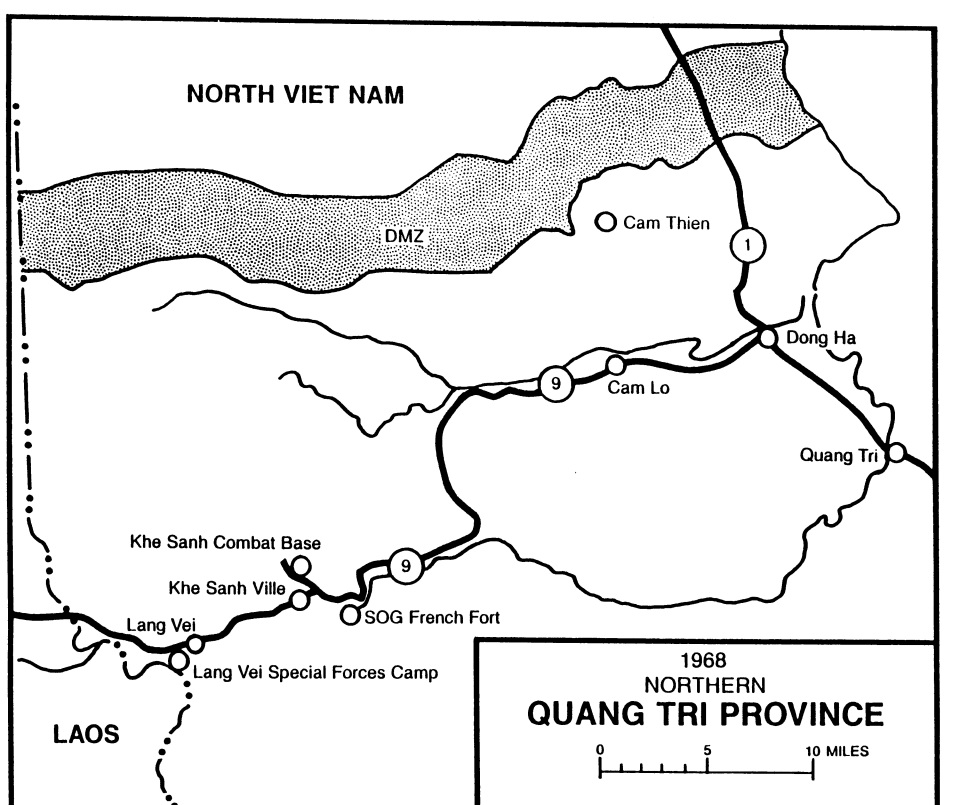
Route 9–the Road to Khe Sanh
Lz Stud was at the turn of the Route from North South to East-West
During the planning process units from the 1st Cav, the 101st Airborne Division and the 3rd Marines were conducting operations along the DMZ as a diversion to the relief operation. The engineers were busy building a short runway and underground bunkers for the command and control of Operation Pegasus near Calu. The new facility was to be named LZ Stud.
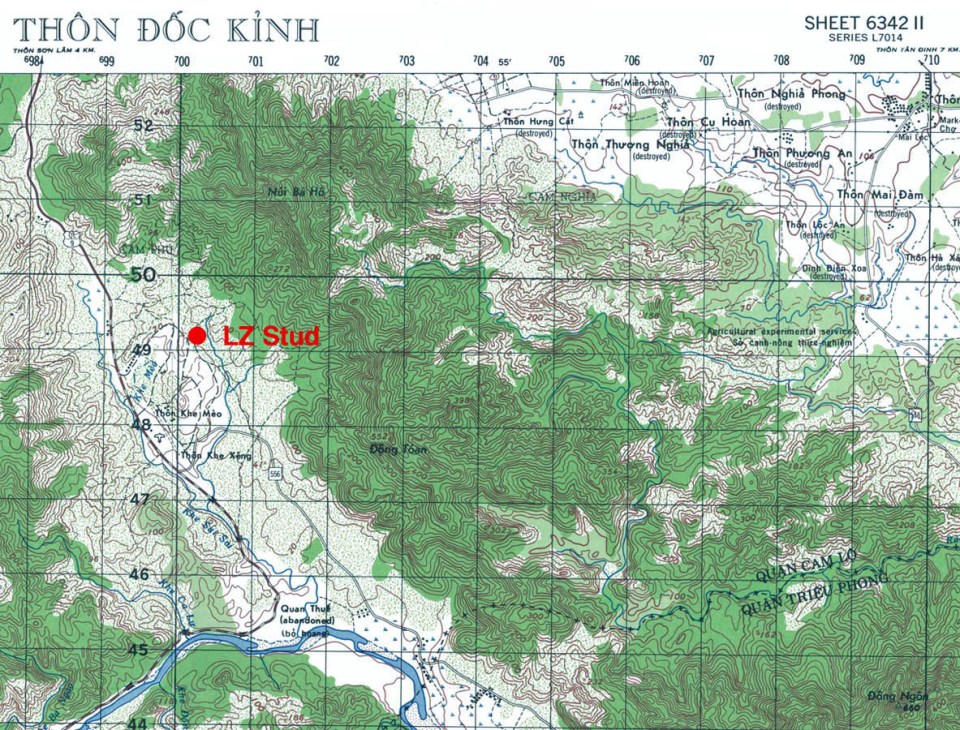
LZ Stud–right before Route 9 turned west
It was located under the range fan of USMC artillery units north and east of here
For Operation Pegasus the 1st Cav had an extensive set of capabilities
- The 1st Cavalry Division with its 400+ helicopters
- A Marine BDE with augmenting engineers and artillery
- An Army of Vietnam (ARVN) airborne brigade
- 26th Marine Regiment +–the whole force defending the Combat Base (5000 strong)
- Massive air support
This was the equivalent of a small Corps.
The attack began the morning of the April 1st with the Marine Brigade attacking along route 9. Its mission was to open Route 9 from LZ Stud to the combat base. This required the repair of numerous road by passes that had been destroyed by the NVA and neglect over more than a year. The air assault was delayed until 1 PM due to fog in the Khe Sanh area. The initial air assault was into areas where the vegetation had been flattened by use a bomb called a Daisy Cutter (a 20,000 pound bomb that was dropped from a C130 aircraft and detonated when the long pipe that was its detonator struck the ground—thus creating standoff and blowing things down without creating a crater). The Infantry and engineers followed to secure the area and move the blow down so that howitzers, crews and ammunition could be lifted in. As a result a firebase was created.
With fire support for support of the infantry and to support the next hop forward closer to Khe Sanh the next unit could be inserted and the leap frog towards the combat base and the enemy could continue.
It was on this day 1 April 1968 when the war was lost. Major Paul Schwartz and I had to brief General Tolson on the proposed concept for the Division’s next mission—clearing the NVA out of the A Shau Valley (about 40-50 kilometers south of Khe Sanh. There were 4 people present at the briefing—General Tolson, his Chief of Staff, Major Schwartz and myself. We proposed attacking through Khe Sanh to the Vietnam-Laos border. Going into Laos, cleaning up the Ho Chi Minh Trail and then turning south to enter the A Shau Valley for the west—not the traditional route which was from the east. There were 90 days of supplies at Khe Sanh to draw upon and thus not have to back haul. Most importantly such an approach would have caught the NVA by surprise and had war winning effects.
After about 4 minutes of briefing General Tolson said” “Obviously you didn’t hear the President last night! What you are proposing is politically impossible.” Lyndon Johnson had just announced a partial bombing halt in an effort to enter negotiations with North Vietnam.
3 years later the US was to support ARVN in Lam Son 719A which was an attack into Laos where the ARVN got clobbered. The NVA had used the 3 years to recover. A year or so later President Nixon was to start the B-52 bombing missions over Hanoi and Haiphong. These would result in a peace agreement.
President Johnson’s bombing halt decision was when the US decided to not try and win the war on the battlefield—just as the NVA were on the throes of collapse. There war was winnable after the eventual Khe Sanh and Tet victories, but the political climate in the US had so turned against the war there was no political will to try and win on the battlefield.
In coming articles we will talk about the bigger lessons learned from Khe Sanh and other conflicts. It is my hope that someday some wanna be strategists will read these articles and learn something from them.
Whence goes North Korea?
North Korea has recently announced a willingness to:
- Meet in a summit of the Koreas
- Defer its nuclear and missile testing while seeking some form of negotiated agreement
- Stated a willingness to de-nuclearization in exchange for some form of non-aggression effort from the US.
The recently concluded Winter Olympics provided a scene changer and face saving opportunity for the North Koreans. Behind the screen of the Olympics the North Koreans could say that the atmosphere of détente offered by the South and the world conclave showed a different face of a world willing to talk to the Koreans. It might be that the continuing tightening embargoes and financial and trade isolation of the North was finally being felt. Those who oppose President Trump’s saber rattli9ng will be quick to jump on this position. They will also quickly seek a loosening of the military build-up and potentially the offer of lifting of trade restrictions to show good faith. To say that this is what the North Koreans are seeking would be an under-statement.
The North Koreans played a similar game with Presidents Clinton, Bush and Obama with the desired results. The North Koreans have demonstrated a much longer view of history than past US administrations. The North’s bellicosity is reduced, promises made, military preparedness reduced and from Clinton energy and trade concessions made in exchange for what? Words? What concessions in reality were made? NONE!
A program of international inspections to verify the dismantling of certain production facilities—nuclear and missile technologies—is what is required for there to be a meaningful change in the situation on the Korean peninsula. Will the North Koreans agree to such terms? Will the South Koreans have the backbone to hang tough in demanding such terms in the face of numerous promises and possibly even the renewal of family visits? That would be tough for the South Koreans to do.
In short while the North Korean words sound good, we are a long way from a meaningful resolution to this almost 75 year old growing problem. This will require continued vigilance and as Ronald Reagan said: “Trust but verify.”
Behind the smoke screen?
President Trump’s tweets and what seem to be off the cuff remarks are providing a perfect smoke screen for the media that want to focus on what they think is outlandish rather than do good journalism and find out what is happening behind the smoke screen.
Behind the smoke screen and the bluster and the magician act that the President is using to focus attention there seems to be a lot going on. Hate for Trump, which the President thrives on, is allowing strategic activity that would remind one of the Kissinger days when the bureaucracy was busing doing busy work while real strategic moves and ground work were occurring behind the scenes.
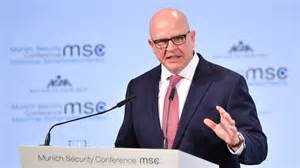
National Security Adviser Lieutenant General H R McMaster
If one follows the National Security Adviser LTG H R McMaster there is not much to see until this last week. During the annual Munich Security Conference he seems to have emerged and has laid down several markers:
- Used the incontrovertible truth that Russia sought to sow instability in the US elect ion process as a background to say that it was impossible for the US to work with Russia on cyber issues.
- Called for action against Iran while scolding those states that traded with Iran for giving the terrorist sponsor a blank check
- Called for action against Syria for using chemical weapons again
In addition he orchestrated the current Olympics lowering of the volume with North Korea. One can readily see the North Koreans using the very fragile détente with South Korea coming out of the Olympics as an excuse for a “delay” in missile testing.
One can be sure that both LTG McMaster and Secretary of Defense Mattis, who has also adopted a low profile, are very aware of the trategic weapons growth by the Russians and Chinese and are laying long term plans to address the potential imbalances.
As the remarks in Munich indicate relations with Russia and the current sanctions will not improve until Russia makes a positive move in the Ukraine or elsewhere. In the meantime the nuclear modernization announced by the President will go on unabated. Is the ground work being laid for a new round of arms control negotiations in 2019?
If the naval armada that has gathered in the South China Sea as a deterrent to North Korea starts migrating towards the Persian / Arabian Gulf one can anticipate the screws being applied against Iran. Obviously Secretary of State Tillison and LTG McMaster’s trips to Turkey and discussions with the Saudis and Israelis have laid the groundwork for such actions. These discussions also have further provided the venue for a consensus on how to deal with the continuing Syrian debacle.
In the first year of the Trump Administration while working behind the Trump smokescreen Trump’s National Security Strategy (NSS), was put together by McMaster’s team. It champions a realpolitik worldview that puts American national interests first and sees the world as a competitive stage. “The United States will respond to the growing political, economic, and military competitions we face around the world,” the NSS states.
Additionally, it has a focus on “revisionist powers” China and Russia and “rogue regimes” North Korea and Iran as acting in ways that are against American interests. “China and Russia challenge American power, influence, and interests, attempting to erode American security and prosperity. They are determined to make economies less free and less fair, to grow their militaries, and to control information and data to repress their societies and expand their influence. At the same time, the dictatorships of the Democratic People’s Republic of Korea and the Islamic Republic of Iran are determined to destabilize regions, threaten Americans and our allies, and brutalize their own people.”
The strategy development in which the entire national security apparatus –State, Defense, and Intelligence Agencies etc.—participated took a year. The media has given little attention to this strategy complaining that it is lacking in detail. One is now starting to see the details based upon that the interests and objectives that were clearly defined and agreed to across the government. In their most likely timeline now is the time for the deliberate but well thought out execution behind the smoke screen provided by the President.
It will be fascinating to see the media reaction as they see behind the smoke. Or will they given their Trump hatred?
The siege of the Khe Sanh Combat Base—the noose tightens
Recently, when reading my VFW magazine I encountered an article entitled Tanks in the Wire”. It was a brief, but still not accurate, synopsis of the battle of Lang Vei Special Forces camp on 7 and 8 February 1968—50 years ago. (I would commend David Stockwell’s two books on the battle. First came Tanks in the Wire and just recently The Route 9 Problem) I was underground in my bunker at the Khe Sanh Combat Base (KSCB) but listened to much of the battle on the radio and the next morning was part of the planning for the relief effort for the beleaguered forces at Lang Vei.
To put the battle in perspective it actually started at the end of January when the 33rd Royal Laotian Battalion was overrun by the North Vietnamese Army (NVA) in Laos using tanks. The Studies and Observation Group (SOG) Special Forces at Forward Operating Base 3, which was an appendage to the KSCB and where we had the local Vietnamese government in exile, had a close connection to the Laotians.
Lang Vei Special forces Camp was located on the Tcepone River and very close to the Laotian border. The scale shows that the distance from Lang Vei to KSCB was about 10 miles or at the limits of the range of the artillery from KSCB.
When the Laotians reported that they were overrun by tanks nobody believed them. The 33rd Battalion fled Laos and settled at Lang Vei in a camp near what was called the “new” Special Forces Camp. They were reinforced by Special Forces elements from Hue Phu Bai lead by LTC Schungel. So now there were two Special Forces camps at Lang Vei—the old camp with Laotians and Special Forces in it and the new camp with A 101 and its Vietnamese Civilian Irregular Defense Forces (CIDG). CPT Frank Willoughby, the commander of A 101 Special Forces detachment at Lang Vei requested anti-tank mines but his request was denied because the report of tanks being used was not believed by higher headquarters. The Special Forces did provide some Light Anti-Tank Weapons (LAWs).
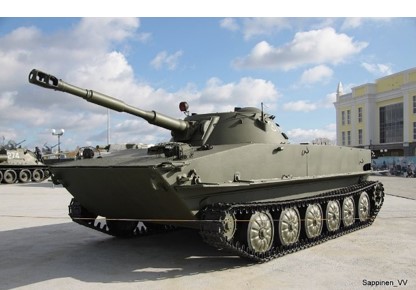
Soviet built PT 76 Light Amphibious Tank–5 or 6 were used to attack the Lang Vei camp. Several were knocked out by the defenders and several more by air strikes. One ended up sitting on top of the command bunker. There is a monument at Lang Vie today celebrating the over-running of the camp which includes a PT 76.
The scene is now set with two camps near the Bru village of Lang Vei and track sound (moving tanks?) being heard on several evenings before the attacks. On the evening of 8 February the new camp was hit with artillery and mortar fire followed by an infantry attack led by PT 76 light amphibious tanks. The forces fought back and called artillery from the KSCB on the attacking NVA. Some of the LAWs failed to operate correctly and many of those that did were ineffective. Between LAWs and 106 mm recoilless rifles the defenders were able to destroy 6 tanks.
Eventually, the defenders of the new camp either secluded themselves in the deep underground command bunker or fled to the old camp. The fight continued all night long. CPT Willoughby requested reinforcement by the Marines from KSCB, but was turned down twice!
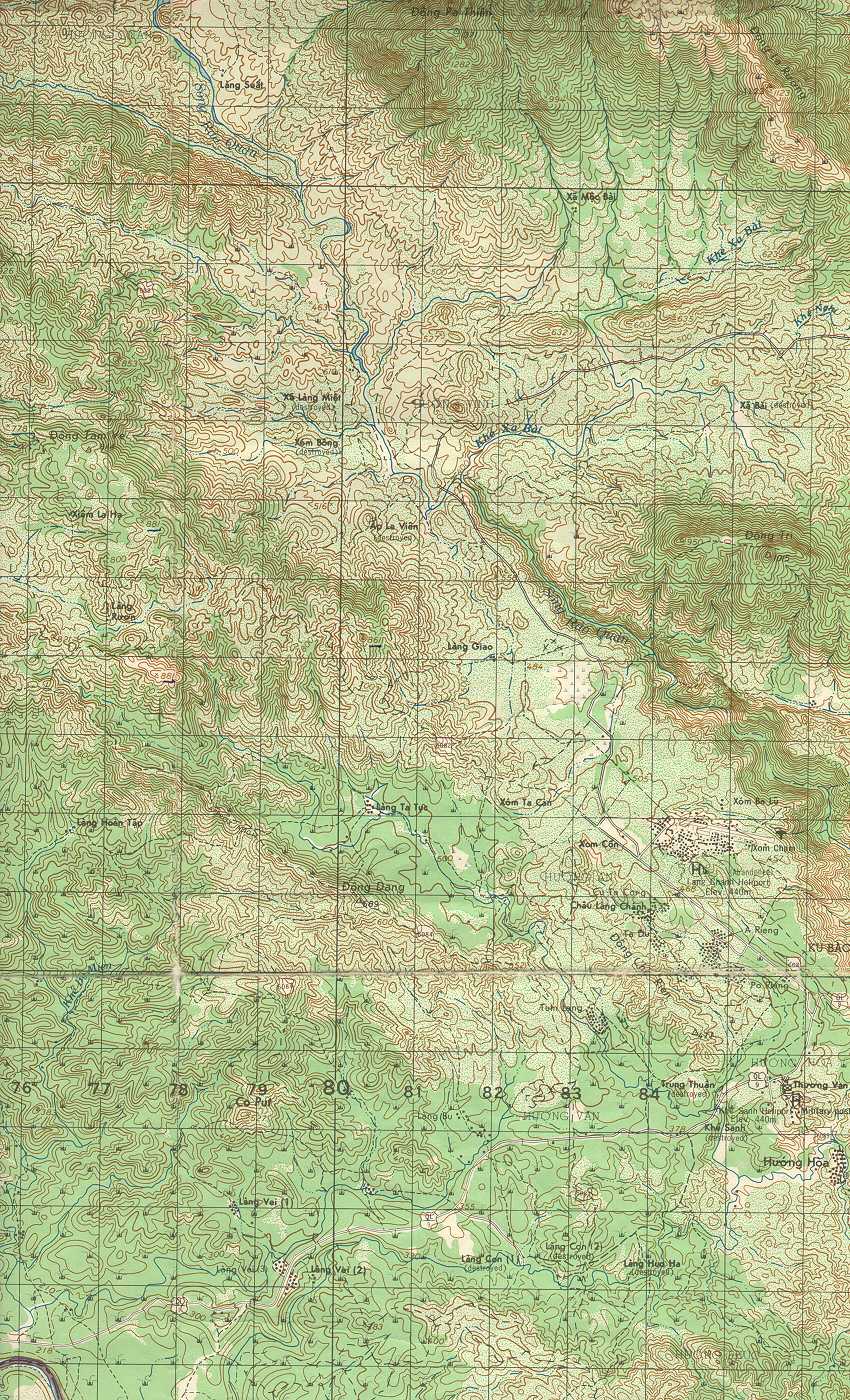
If one looks at the terrain he can easily understand how much of a tough slog it would have been to get form the upper right corner of the map to the lower left–multiple possible ambush sites. There are also reports that several of the PT 76s had been moved to cover possible landing zones. Still the Marines said NO! and left the soldiers at Lang Vei to their own devices.
Communications from the command bunker became difficult with the antennas knocked down but the single side band radio with its buried antennae continued to allow communications to the outside. At this point there was a PT 76 tank on top of the command bunker and the NVA were throwing tear gas down into the bunker. CPT Willoughby and his crew continued to communicate.
Forces from the old camp, supported by artillery and air strikes made up to five attempts to reach the bunker with no success. The 7 weak from wounds and dehydration survivors in the bunker made their plans to escape. CPT Willoughby told the aircraft overhead to make 3 hot strafing runs over the camp and then make runs without firing. During the “dry” runs the survivors would make a dash to the old camp. Actually it was to be more of a limp. The survivors met little opposition and with the help of a brave Vietnamese Lieutenant who drove a jeep to pick them up made it to the old camp.
The final saga of the battle was the evacuation. There are several versions who the fight for helicopters, but COL Ladd, the 5th Special Forces Commander in Danang was forced to go to General Westmoreland who was in a meeting with LTG Cushman (the Corps Commander) and could not be disturbed. COL Ladd turned to GEN Abrams who had established a MACV forward command in the northern part of the country. GEN Abrams ordered the Marines to release the helicopters to rescue the survivors of the battle. The relief operation was planned by the Special Forces at FOB 3 and lead by Major George Quomo. After reluctance of the Marine CH 46 helicopter pilots to land at the old camp was overcome the Americans and the wounded along with the Laotian Battalion leadership were evacuated by air to KSCB and then once medically treated were taken to Danang. The individual soldiers and the Bru civilians were left to fend for themselves. They walked the distance to the combat base where they were disarmed and turned away. (This was to create a political incident between the Laotian government and MACV.) I radioed Quang Tri thru my radio relay that the 1500 or so mixed group was on its way. The advisory team in Quang Tri prepared to house and care for these stragglers. The Laotians were evacuated through Saigon back to Laos.
Route 9 was now not impeded—the Lang Vei and District Headquarters impediments had now been removed. The route to the KSCB was now open and the noose had been tightened.
 Bruce B.G. Clarke