Home » Uncategorized
Category Archives: Uncategorized
Update on the war in Ukraine
At the macro strategic level nothing has really changed. The battlefield dynamics have changed with Ukraine’s invasion of Russia near Kursk and Russian advances near Pokrovak.
The real issue is that neither side has found a way to terminate the conflict. The Russians failed to size Kyiv at the beginning of their invasion and since then the conflict has become a war of attrition. Both sides are seeking termination by exhausting the other. In such a conflict Russia has the advantage in national manpower and strategic stockpiles. However, Ukraine has the advantage with better fighting skills, especially at the tactical and operational levels. Both sides are heavily dependent on “allies”. Russia on China and North Korea and Ukraine on the NATO members. The Russian’s allies are supporting it for payment and closer ties. The NATO allies are supporting Ukraine as a way of preventing Russia form attacking the alliance—especially the recently joined Baltic states.
So how does an attrition war end? One side or the other says it has had enough and withdrawing from the battlefield. This is easier for the Russians to do than the Ukrainians. At the worst the Russian would lose Crimea and much more importantly “face”. It would be difficult to claim to be a “world power” except because of its nuclear arsenal. For Ukraine the withdrawal from the conflict would be catastrophic as it would amount to the loss of its political freedom. As long as allied support continues and neither side wins a strategic victory one the battlefield the blood letting will continue.
The Ukrainian attack into Russia has slightly altered the equation as the political and actual losses have been increased several fold. Ukraine’s ability to attack military and economic infrastructure targets in Russia has increased as a result of the increased proximity to targets. This ability to cause more damage and thus up the cost to Russia is potentially a dramatic factor in the conflict/ Had Ukraine been able to conduct a blitzkrieg like battle and roll up the attacking forces elsewhere on the battlefield could have resulted in a battlefield victory. But Ukraine did not have the forces to encircle the forces opposing it elsewhere on the battlefield.
Similarly the Russian advances towards Pokroyak have created a significant penetration into Ukraine. However, Ukraine has held the shoulders of the penetration creating an offensive opportunity that reminds one of the famous battle of Kursk during World War II when the Soviets held the shoulders and limited the depth of a German attempt to penetrate the Soviet lines and then counter attacked to destroy a large German formation and forced a German withdrawal which signaled the beginning of the end of the war on the Eastern Front. One has to seriously doubt that Ukraine has husbanded the necessary assets to conduct the pincer-like attacks to seal the penetration and deal a disastrous loss to Russian forces.
As we consider the chess board that is the Ukrainian battlefield one must wonder if there is a battlefield solution to the war? (It is critical to note that the use of nuclear weapons by the Russians has not been considered in this whole discussion. Such use would change the entire dynamic of this conflict and must be dealt with in a subsequent effort,) At this writing the offensive actions of both sides do not provide a change of the strategic nature of the war. It remains a war of attrition. Th only way it will temporarily end is some form on negotiated ceasefire. The term temporarily is used intentionally because the end of this conflict will only be the beginning of the next one.

New news: The Russian attack on Pokrovak appears to be advancing and the defenses are not likely to hold. Simultaneously the Ukrainians are expanding the seized terrain near Kursk. The Russians just launched a large-scale drone and missile attack killing at least 40 at a Ukrainian military school. Most certainly Ukraine will respond. Finally, it is reported ed Zelenskyy is travelling to the US with a new proposal to end the conflict. To guess what the proposal is difficult, but a personal guess is that he is going to ask the Biden administration to remove the limits on attacking Russian soil with US weapons. That may be coupled with a request for longer range missiles that would put Moscow at risk. Such a threat would provide leverage to negotiate a ceasefire followed by subsequent negotiations. We’ll see.
Has the Corps?
When I was a cadet at West Point and over the almost 60 years since I was graduated, I have heard older alumni and now some of my own classmates, since we are now older alumni say: “The Corps has.” The meaning of this is that the Corps of Cadets has gone to hell because this or that changed since we were cadets. The current hubbub of “the Corps having” is about the dropping of the West Point motto of “Duty, Honor, Country” from the United States Military Academy (USMA) mission statement.
When I first read of the newest concern that ‘wokism” was becoming more dominant at West Point I immediately wen to the bible of my father’s time and mine-The Bugle Notes. Each plebe when he enters West Point is given a copy of The Bugle Notes and required to memorize certain contents such as:
- The Corps
- The Alma Mater
- The mission of the United State Military Academy
- Some football cheers and songs such as On Brave Old Army Team
- Etc.
In neither my father’s Bugle Notes published in 1934 nor mine published in 1961 did the USMA motto of “Duty, Honor Country” appear in the mission statement. The motto was not added to the mission statement until 1998. And now it has been replaced with the term “Army values”. This term is really what has excited those who want to say that the Corps has. They fear that this term is a buzz word for some diversity, equity or inclusion initiative (DEI). There are several points about this concern. First many former and current graduates of the military academies and other serving members of the US military are rightly concerned that DEI activities in the military are divisive–not team building and threaten the teamwork that is required for a military unit to function with the highest effectiveness and efficiency.
In the last year or so there are at least several organizations primarily made up of service academy graduates that are seeking to be a voice against DEI in the military—STARRS and the MacArthur Society are two that stand out. To say that the concern about DEI in the service academies is real would be an understatement. Therefore, the concern about the term ‘Army Values.”
The Army basic training manual stresses that new recruits must learn what the words Loyalty, Duty, Respect, Selfless Service, Honor, Integrity, and Personal Courage mean. The manual goes on to stress that these seven these “Seven Core Army Values are what being a Soldier is all about.” In reading the meaning of each of these values one can find some greatness in every soldier who abides by these values. The Army acronym for these values is L.D.E.R.S.H.I.P. However, the devotion to country is not as clear and sharp as it is in the West Point motto. In the discussion of Loyalty, it says; “Bear true faith and allegiance to the U.S. Constitution.” But it does not link that statement to the country that was founded based upon the U.S. Constitution. This may be a weak link.
The weak link is trumped by the continued emphasis on the three hallowed words; “Duty, Honor, Country.” For the younger reader you should know that the speech General Douglas MacArthur gave at West Point in May of 1962 was based on the reverence and criticality of those terms. Some may say so what? I was on the plain at West Point when the General trooped the line standing in a jeep with Major General William Westmoreland and the First Captain of the Corps of Cadets Jim Ellis. I was also in the audience with spring athletes in their uniforms of the day—football, baseball, tennis, etc.– sitting on the floor in the aisles of the “mess hall” when General MacArthur made that speech without a note. (https://nationalcenter.org/ncppr/2001/11/04/general-douglas-macarthurs-farewell-speech-to-west-point-1962/) To this day I can vividly remember his demanding that: “Duty, Honor, Country: Those three hallowed words reverently dictate what you ought to be, what you can be, what you will be. They are your rallying points: to build courage when courage seems to fail; to regain faith when there seems to be little cause for faith; to create hope when hope becomes forlorn.”
So, for today, if the Corps of Cadets and all past and future graduates abide by the West Point motto and MacArthur’s admonition about the three hallowed words, the term “Army Values” in the new West Point mission statement is less worrisome. In fact, future leaders must learn and understand the values that their future troops are being taught.
I hope that coming out of this whole ‘hubbub” is a renewed interest in “Duty, Honor, Country” and ensuring that the Corps never has.
The dangerous Iranian dilemma
President Biden vowed to respond after a drone strike by rebels I n Syria linked to Iran killed three U.S. service members and wounded at least 34 others. The drone hit American troops stationed in northeast Jordan near the Syrian border early Sunday. The Islamic Resistance in Iraq, a coalition of militias backed by Iran, claimed credit for the attack. “We had a tough day last night in the Middle East. We lost three brave souls,” Biden said during a stop at Brookland Baptist church in West Columbia, S.C. After leading a moment of silence, Biden said: “And we shall respond.”
The Iranians’ proxies—Houthis, Hezbollah, Islamic Resistance, and Hamas, to name most—are each and all attacking western and Israeli targets in multiple regions of the Middle East. The critical question is why? The obvious answer is to force the Israelis to cease their attacks in Gaza. One more piece of the overall intimidation strategy against everyone who supports Israel whether they be countries, political groups or commercial interests. A well-orchestrated multi-faceted political strategy to cause pressure to be brought to bear against supporters of Israel and thus Israel itself.
The obvious answer has resulted in air attacks against the Houthis for attacking shipping in the Red Sea. The multi-faceted political attacks have caused pressure from the Biden administration on Israel for cease fire periods, a two-state solution, etc. However, this is not the ultimate Iranian goal. The Iranians have a Middle East domination goal. To accomplish that their proxies need to eliminate their close in adversaries. The Iranians also need justification for the acquisition of nuclear weapons as an instrument in their domination. Perceiving the West (and especially the US) as weak, timid and bogged down in Ukraine they perceived this as the perfect time to launch this region wide assault. Should the US respond directly against Iran it must do so dramatically and devastatingly! Iran must be shown as a paper tiger and suffer a huge setback to its nuclear ambitions if the domination objective is to be denied. Success in such a limited but dramatic coordinated attack is probably not considered viable or politically beneficial by the non-strategists in Washington who have gotten the country into this dangerous dilemma.
One can be sure that the pseudo strategists are putting in extra hours trying to come up with a response that shows some degree of strength while not causing the Iranians to directly react vehemently—especially against the Gulf Cooperation Council states who produce a significant amount of the world’s petroleum.
The response that President Biden promised is going to be a dramatic event. It will either be so weak as to signal that politically a response was necessary but that the US is afraid of Iran and its proxies. Or it could be sufficient to justify the Iranians escalation or de-escalation. One must wait.
Hamas-Israel conflict strategy (continued)
This is the third in the series about strategy and the current Middle East conflict.
The Biden administration has adopted a deterrence strategy in the Middle East based upon an expectation that the Israel-Hamas conflict will escalate. The administration appears to have intelligence that the Iranian proxies (Hezbollah and either Iranians or Syrians operating from Syria) are prepared to expand the conflict. There is also newly arrived in the area a small flotilla of Chinese warships.
Hezbollah has been launching some rocket attacks into northern Israel. There have been several attacks coming out of Syria and even some cruise missiles from Yemen. A US destroyer destroyed the cruise missiles while several attacks wounded one American in Syria.
The question is whether the deployments are too much or not enough for deterrence and if necessary for war fighting. To date there have been two carrier battle groups and several squadrons of Air Force A-10s and support aircraft forward deployed. Secretary of Defense Austin announced yesterday the deployment of PATRIOT and THAAD air defense systems to protect US Forces—locations not disclosed.
Secretary of State Antony Blinken and Defense Secretary Lloyd Austin said Sunday that the United States expects the Israel-Hamas war to escalate through involvement by proxies of Iran, and they asserted that the Biden administration is prepared to respond if American personnel or armed forces become the target of any such hostilities.
“This is not what we want, not what we’re looking for. We don’t want escalation,” Blinken said. “We don’t want to see our forces or our personnel come under fire. But if that happens, we’re ready for it.” Austin, echoed Blinken when he said “what we’re seeing is a prospect of a significant escalation of attacks on our troops and our people throughout the region.”
Currently the Israelis have not asked for US intervention. Israeli warplanes struck targets across Gaza during the weekend, as well as two airports in Syria and a mosque in the occupied West Bank allegedly used by militants. Israel has also traded fire with Lebanon’s Hezbollah militant group on a near-daily basis since the war began, and tensions are soaring in the Israeli-occupied West Bank, where Israeli forces have battled militants in refugee camps and carried out two airstrikes in recent days.
In past conflicts Israel has fought on several fronts very successfully. They apply economy of force to contain one or more threat while they eliminate the one that they see as most dangerous. The ability to rapidly move troops from one side of the country to another (internal lines of communication) allows them to rapidly reposition forces.
One could easily conclude that Israel has not started its ground offensive into Gaza yet as it seeks to determine which threat is the most dangerous. Once the Israeli ground forces enter Gaza it would be difficult to disengage to fight elsewhere. Conversely, the other Iranian proxies may be waiting for Israel to commit its forces. In the meantime, Israel will continue to pound Gaza and elsewhere from the air and with artillery. One should not expect this waiting game to continue ad infinitum.
There is news reporting that the reason that Israel hasn’t attacked Gaza yet is because the Biden administration is seeking a hostage return in exchange for a ceasefire. This is denied by some administration officials while quietly “sorta” suggested by others. The administration is having difficulty talking with one voice.
In the near term the supplies reaching Gaza through Egypt will remain minimal, with pressure mounting for more aid to be allowed / provided.
Another possible reason that Iran and others may be seeking to extend the conflict is because of the resource consumption rate. At some point Israel is going to need ammunition and possibly other resources from the US. At the same time Ukraine is rapidly consuming American resources. Would the US have sufficient resources remaining to prevent China from attacking Taiwan? OR would the US have to reduce support for Ukraine and thus facilitate Russian advances? These are all questions worthy of consideration as one seeks to understanding seeking to deter rather than fight and why deterrence may be more difficult.
The threat of escalation is also suggested by the presence of 6 Chinese warships entering the area. Engagements started by the Chinese would be an escalation of significant proportions. Should the US deterrence fail and its troops, ships or personnel be actively engaged this would/could be a game changer. Biden has dug himself a hole and must either respond dramatically and thus widen the conflict he seeks to deter or slink back to his beach house. The prospects for the future are thus more complicated.
Stand by for the next turn in events.
Understanding Hamas (continued)
Since writing the first piece on the Hamas strategy in its war of atrocities on Israel the picture has become much clearer. The strategic goal of Hamas, based on their constitution is the destruction of Israel. That goal has not changed! What has changed is the methodologies of achieving that goal. The means used to achieve their goal include propaganda, rockets and terrorist activities. The “Rules of War” do not apply.
Hamas (and Hezbollah?) continue to be Iranian proxies. Iran has the elimination of Israel also as a goal, but probably for different reasons. Iran seeks to dominate the middle-east. To do that it must eliminate Israel. After reducing the American threat by pretending that it would enter into an agreement to not produce nuclear weapons the US in exchange for 5 hostages released $6B. (The call to refreeze those funds has so far fallen on deaf ears at the White House.) The next step was to continue the antisemitic sentiments that had been fostered throughout the world using Muslim refugees and other pro-Arab thoughts in universities and colleges around the world funded by mostly Saudi money. (Funny that the Sunni funds have been exploited by the Shiites.) The Iranians also had to destroy or at least delay the approaching rapprochement between Israel and Saudi Arabia. They knew that the Saudis could not side with Israel against the Palestinians. This knowledge led to the current strategy of atrocities and hostages waged against the Israelis. The differences between the Sunni and Shia Muslims are hidden in the current propaganda war.
The hostages are a key component to the execution of the strategy. Israel cannot attack the Hamas tunnel complexes using salt water to flood them as it has in the past because the tunnel might have hostages in it. This has contributed to the lack of speed in the Israeli invasion of Gaza. They are seeking to figure out where the hostages may be in order to attempt to minimize their vulnerability during the upcoming assault.
Tunnel warfare is dirty and dark work. The easiest way to attack a tunnel is to flood it or fill it with some form of gas that either explodes, incapacitates or kills the tunnel occupants. Ultimately the tunnels need to be destroyed.
The threats to open second and third fronts against Israel—Hezbollah on the north and Iran through Syria on the east are just threats to tie down Israeli forces and make the agony of Palestine continue to play in the media over a longer period of time. Israel’s need to station troops to deal with those possible attacks means that those assets are not available to attack Gaza. This agony it is hoped will further isolate Israel. It almost appears that the pro-Palestinian factions around the world were expecting the hospital attack—the counter Israel demonstrations broke out so soon after the initial false claims by Hamas’s propaganda arm. Examination of the attack area and radar and video recordings prove that the missile was fired by Hamas. The final number of casualties may be small, though quite a few cars next to the hospital were destroyed—burned not exploded. But the propaganda value has been achieved. Was it intentional?
The hospital attack also served to break up President Biden’s attempt to be a peacemaker by meeting in Jordan with three political heads of state. The termination of this meeting may have contributed to the President’s stated goal of giving $100M to the Palestinian recovery fund. This may be hard to get out of the Congress right now.
As this conflict continues to fester strategic goals and objectives may change with the tactical realities, but in the long run Iran will continue to seek dominance in the region and Israel will continue to seek to survive and prosper.
What is not known and may become the hugest sore for Israel is post-war Gaza. Israel will not want to permanently occupy Gaza for a whole host of reasons–cost, providing targets for continuing terrorist attacks, the difficulty inherent in ruling a hostile area, etc. To date there has been little discussion of what the region will look like in a post conflict world. This should be a subject that is keeping Israeli strategists worrying once they can refocus away from the continual propaganda that flies at them every second of every day. Food distribution and rebuilding requires a government in Gaza and it is hard to imagine that Israel wants that mission.
This series will continue as events dictate further explanations and revisions to the strategic environment.
Understanding Hamas’s Strategy
As one ponders the intent behind Hamas’s unconstrained violence of the last five days true strategic understanding is difficult to achieve. They jihadists have always acted in extremely passionate ways. However, this time they seem to have exceeded their own bloody norm. Why?
Figuring out the beheadings and random killing of women and children is not easy. The Palestine apologists all claim that every citizen of Israel is a colonist on their land. Therefore, they must all be killed. The Palestinians / Hamas have been heavily armed by Iran and Afghanistan, among others, but they do not have the wherewithal to destroy Israel. Attacking now may even set back their ability to attack again for years if not a decade. At the rate of destruction that is occurring in Palestine there may only be rubble left in the Gaza strip. A poverty ridden population which has seen much of the aid money poured into the country go for weapons of war, not for improving the lives of the people will again seek to kill the colonizer—Israelis. Following this latest “war” the plight of the people most likely will be worse. They have ignited a passion among the Israelis which had been becoming dormant. The reduction in fear led to the disarming of much of the population—that has been reversed. This Israeli passion will cause great destruction to Gaza which will take many years to rebuild. Given the eventual embargoes that will most likely be imposed importing materials and goods and services will be more difficult.
It is in this passion—on both sides—that a possible understanding of what Hamas seeks to achieve emerges. Hamas and Iran see the US as weak and unwilling to or unable to respond resolutely. The demonstrations and pronouncements from Liberals from Harvard undergraduates to Black Lives Matter may be fueling the Palestinian passion. It is obvious that it is stirring Jewish sentiment in the western world. Even President Biden, whose administration has been currying the Jewish vote while supporting the Palestinians has felt forced to speak out against the invasion. However, once the conflict has ended you can expect millions of dollars to be poured back into Gaza because “it is the right thing to do.”
Hamas may have also seen a loss of passion in Gaza that was brought on by too much peace and even a gradual improvement in the standard of living. To reignite the local population’s ardor in fighting the Israeli “colonists” it may have needed to return the situation to one of total deprivation. I can remember Yassar Arafat saying that he did not want to get the Palestinians out of the camps because in the camps they were controlled and it was easy to ignite their passion. We may be seeing this whole scenario playing out again.
So how does this end? Israel has absorbed significant damage, but nothing to compare to what has / will happened in Gaza. Israeli unity of purpose will be the norm with political diversity set to the side for some time. Gaza will be devastated and bleeding hearts will try to rebuild it and rearm Hamas, but it will take time for the images of decapitated babies to disappear.
The most optimistic outcome is that the Palestinians will decide that they have had enough of the agony brought on by fighting Israel and will opt for a more accommodating approach. And of course, this will be the argument to open our borders and increase the national debt. However, the Biden handling of the southern border may have so upset the American people that such an approach will not be possible. The Israeli disarming will most likely set back liberal attempts to limit the applicability of the Second Amendment.
It is also interesting to note that some Wall Street firms are now refusing to hire Harvard graduates that support Hamas. What does this say for the whole Diversity, Equity and Inclusion theology? At this very early in the analysis process the one thing that we can conclude is that actions have consequences and sometimes (often?) the severity of the consequences are not very well thought out.
Ukraine–a hybrid war
Like many of my readers I have been following the war in Ukraine. The introduction of new western weaponry on the battlefield has generally not had the desired effect. The Ukrainians have not routed the Russians and given the state of play most likely won’t. Warfare on the battlefields of Ukraine has a mixture of 21st century and early 20th century earmarks.
Drones and sophisticated missilry have marked much of the 21st century warfare. Drones have been used as weapons and as sophisticated target acquisition means. In both cases they have been subject to successful engagement by increasing air defense capability. Not discussed in the media, but this increased ability to engage drones means an increase in air defense target acquisition and tracking capability. This increase has allowed for the successful engagement of many types of drones. Drones have been used extensively by Ukraine to acquire targets and then engage them with battlefield artillery. As the range of the engagement capabilities has increased so has the depth of the battlefield for the Ukrainians. Drones and other intelligence collection means have provided accurate targets for engagement by increasingly more sophisticated artillery and air delivered ordnance. For the first time we are seeing Ukraine able to engage depots of Russian supplies in western Russia.
Conversely, the Russians have not had the same level of success with their Iranian supplied drones in this type of combat or engaging targets deep in Ukraine. The current intimidation attacks on the grain port and civilian targets near Kyiv have only been marginally successful. The attacks on the Ukrainian grain export port and the threats against ships coming into port to export the grain are a significant escalation by Russia. It would seem that the Russians are hoping that this escalation could cause the Ukrainians to make some concessions. As I sit on the Danube and see empty grain barges moving towards Austria and Hungary I have to wonder if this is an alternative export means about to happen.
The time lapse between the cessation of most Russian offensive action and Ukraine’s spring/summer offense provided time for the Russians to build a classic Word War I or II defense in depth. Trench lines in depth, minefields and booby traps characterize the Russian defenses. Modern armor is not designed to slog through such defenses. It is designed to exploit disruptions of the defense to conduct rapid assaults against the unprepared 3rd echelon and logistical forces. Open maneuver warfare on the plains of the Ukraine is much different than slogging through minefields and trench lines manned by infantry with anti-armor weapons. The use of cluster or scatterable munitions may reduce the enemy in strong points to allow penetrations especially if they can detonate mine fields and eliminate Russian anti-armor crews. To date the jury is still out on the Ukrainian ability to figure out how to penetrate the Russian defenses.
In all this war has all of the earmarks of World War I—attrition warfare. The daily battles are characterized by a large amount of artillery being fired against sometimes fleeting targets. It appears with superior counter battery capability, weapon accuracy and superior target acquisition capability that Ukraine’s firing of about 30% fewer rounds is having much more affect. However, in a battle of attrition the numbers are not on Ukraine’s side. It needs to figure out how to conduct blitzkrieg like penetrations of the Russian defenses. This maneuver warfare with superior firepower and mobility of western provided armor/mechanized equipment could be locally successful.
To have significant battlefield success the Ukrainians need to fight this hybrid type of warfare while husbanding their manpower resources to commit it in mass–not spread it over the large areas that mark the lines of contact today. The next few months should be telling.
Remarks at Ponte Dirillo–10 July
Ladies and Gentlemen:
80 years ago, to the minute, brave paratroopers of the First Battalion, 505th Parachute Infantry Regiment, who had parachuted into the area just behind the fortifications to our rear, were fighting off German efforts to attack through this very point to destroy the American First Infantry Division which was coming ashore near Gela. These infantrymen were to link up with the paratroopers in the coming days.
Today I join you not only as a former warrior, but as the son of a true warrior (LTC Arthur
F. Gorham) who was leading those paratroopers who were fighting outnumbered and out gunned to safeguard the landings near Gela. My father gave his life while leading his airborne soldiers against this determined foe at the beginning of the effort to rid Italy and Europe of the scourge of Fascism’s two evil dictatorships. His name is at the top of the tablet behind me.
I am again today reminded of a saying that I had to learn while a cadet at West Point that is attributed to General Douglas MacArthur-“There is no substitute for
victory.” The brave men and women from many countries who struggled with the foe
here in Sicily 80 years ago as part of Operation Husky knew what the sweet taste of
victory would be.
The Allied invasion of Sicily, codenamed Operation Husky, was the major World War II
campaign, in which the Allies took Sicily from the Axis (Italy and Nazi Germany). It was a
coordinated large scale amphibious and airborne operation, followed by six weeks of
intense land combat. Husky set the stage for launching the campaign to liberate the rest
of Italy. The lessons learned from Operation Husky made the landings at Normandy possible. It all began right here!
My friend, Senore Ventura, whose farm we are at today, remembers observing as a young boy the fighting and dying that occurred right here where we celebrate the feats of those brave warriors who fought here for freedom. History was made by these brave men. It was the first nighttime mass parachute drop ever. It was the first true test of combined military operations by a military coalition. At midnight on July 9/10, 1943 these men would leap into Sicily totally unaware that scores of German panzers were lurking just inland in the darkness.
For many of the American forces and for the entire Canadian contingent, this was their first time in combat. They learned here what it meant to win on the battlefield against a determined foe.
Today the nature of warfare has changed. It is unclear what constitutes victory in the
current political climate in the eyes of the media. What is the taste of victory? We fight against terrorists who know no rules of war and who want to deny us our freedoms. Very pertinent to today is what Winston Churchill said in 1940 before the United States entered World War II: “Victory at all cost. Victory in spite of all terror. Victory no matter how long and how hard the road may be; for without victory there is no survival.”.
As we contemplate the sacrifices made 80 years ago let us insure that the warriors’, who died freeing the world from Fascism and later communism, lives will continue to be relevant in our search for freedom from the tyranny that terrorists and others would impose on us. We as an international community must remember that for without victory there is no survival. Those brave men and women of 80 years ago understood this–do we?
Let me close by reassuring those who gave their lives for freedom that we understand
their sacrifice by reciting The Absent Legions by – Edgar A. Guest
Somewhere, far away, ‘they heard us
When the word of Victory stirred us.
Safe within God’s Holy keeping,
Heard us cheer and saw us weeping;
Shared in all we did or said-
Freedom’s glorious, youngest dead.
Never doubt it, there was gladness
Where the dead are done with madness,
Hate and hurt, and need for dying.
As they saw our banners flying
On our day of joyous pride,
” ‘Twas for this,” said they,
“We died!”
What if tears our eyes had blinded.
As of them we were reminded?
Never doubt it. they were voicing
Somewhere. songs of great rejoicing;
Glad to look on earth and see
Safe our country. still. and free.
Finally, I want to thank Senore Ventura and all of our Sicilian friends for the warm hospitality extended to my family and all who celebrate freedom. In our 4 visits to this hallowed ground, we have been warmly received and we appreciate the friendship that has not only been developed here but between our two nations.
May God bless the warriors listed on the memorial behind me and all of the warriors who died for freedom and each and every one of us.
Thank you!
Part 7: Art Gorham–The battles near Ponte Dirillo
Part 7 The fight near Ponte Dirillo
Art positioned himself and the few dozen stragglers he found on the high ground near Comico airfield. On July 11, when approximately ten German tanks and a battalion of infantry began to assault their position, and all of his men were lying as low as possible, Art was on his feet, dodging incoming fire and moving around the position, bucking up his outnumbered men. When one of the teams manning a captured anti-tank gun was all wounded or killed, Gorham sprang for the weapon, loaded it himself, and went after one of the tanks. He hit the tank’s vulnerable side, setting it on fire. Art then moved from point-to-point firing into the eye-slit of tanks, shouting encouragement to the men and directing their fire until the counterattack was repulsed. For his actions on July 11, 1943, Gorham was awarded the nation’s second-highest award for bravery, the Distinguished Service Cross.
The next day, July 12, Art and his unit came face to face with another German tank unit near Niscemi, Sicily. William B. Breuer in Drop Zone Sicily describes the action: Art “grabbed a rocket launcher and edged his way within range of a menacing Tiger Tank which had continued to roll forward. Gorham, out in the open and in full view of enemy tankers, kneeled to take aim at the tank. Gunners in the Tiger spotted the parachute leader and fired an 88mm shell at Gorham at point-blank range. Gorham, hardnosed to the end, fell over dead.”
The citation for the Distinguished Service Cross he was awarded for his actions reports: “Lieutenant Colonel Gorham personally manned a rocket launcher and destroyed one tank. While attempting to destroy another with hand grenades and a rifle, Lieutenant Colonel Gorham was killed.” The details of this story were later relayed to Gorham’s family by Chicago Tribune reporter John Hall Thompson in December 1943.
Bill Ryder first reported Art’s death in a March of Time radio broadcast on August 19, 1943. “One of the outstanding examples of heroism was Lt. Col. Arthur Gorham, whose unit was attacked by tanks. When one of his bazooka teams was wiped out by an approaching tank, he manned the weapon himself and got the tank single-handed before being killed himself by another tank on their flank.” Ryder was the first American paratrooper and had jumped with Colonel Gavin in Sicily as an advisor. Ryder would later return Gorham’s personal effects to my mother.
Colonel Gavin was to write to my mother, “Most of the combat success of the Regiment in Sicily was due to Art and the men of his command.” After the war, Gavin, by then a lieutenant general, wrote in his memoir, On to Berlin, “Colonel Gorham and his small group of troopers… accomplished all of the missions assigned to the entire regimental combat team. It was a remarkable performance, and I know of nothing like it that occurred at any time later in the war…His death was a great loss to the division.”
General Ridgway probably put this in the best perspective when he wrote, “The action which resulted in his death was typical of his inspiring leadership, for it was he that personally instilled the spirit of the attack at a time that those around him were thinking only of defense, and in person led the attack, which succeeded. His indomitable spirit acknowledged no odds.”

Plaque Near Ponte Dirillo Ceremony to be here on 10 July 2023

Looking north west from the plaque to the fortification guarding the road
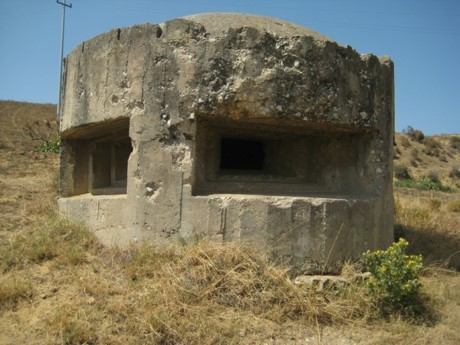
One of the bunkers overwatching Ponte Dirillo
Remarks in Gela 9 July
Ladies and Gentlemen:
Precisely 80 years ago at 8:10 PM the aircraft carrying the paratroopers of the 505th Parachute Infantry Regiment set off from Tunisia. Their mission was to block the roads leading to the landing sites here in Gela to protect the landing forces from attack on their beachheads. One of those paratroopers was my father LTC Arthur F. Gorham.
It is a distinct honor for all of Art Gorham’s descendants to be in Sicily to celebrate his life, his heroism and the heroism of all of the brave soldiers on both sides of the conflict.
History was made by these brave paratroopers. It was the first nighttime mass parachute drop ever. It was the first true test of combined military operations by a military coalition. At
midnight these paratroopers jumped into Sicily totally unaware that scores of
German panzers were lurking just inland in the darkness. This was the beginning of Operation Husky. The allied military operation to liberate Sicily.
Strong winds of up to 45 miles per hour (72 km/h) scattered aircraft widely off course,
and most of the paratroopers failed to reach their rallying points. Those few that did rallied vicinity Ponte Dirillo and in the ensuing days defeated several counterattacks lead by German panzers against the beachhead and thus insured the success of the landings. This small force lead by my father accomplished the Regimental mission and insured that the landings on the beaches near where we are tonight would be successful.
The First Infantry Division (the Big Red One), in which I served twice. Came ashore near where we are tonight and was to link up with the paratroopers as they went on to secure the area around Gela and begin Patton’s steady attacks north on the west side of Sicily, The liberation of Sicily had begun.
My father gave his life while leading his airborne soldiers against a determined
foe at the beginning of the effort to rid Italy and Europe of the scourge of Fascism’s two evil dictatorships. He personally destroyed several German panzers attempting to reach the beaches. For his bravery he was awarded two Distinguished Service Crosses. The Distinguished Service Cross is the second highest award for bravery that the United States military awards.
From Sicily the allied forces who had liberated Sicily were to attack the Italian mainland and a year later came the Normandy invasion. Normandy was possible because of the lessons learned liberating Sicily.
Today the nature of warfare has changed. It is unclear what constitutes victory in the current political climate in the eyes of the media. What is the taste of victory? We fight against foes who know no rules of war and who want to deny us and our allies our freedoms. Very pertinent to today is what Winston Churchill said in 1940 before the United States entered World War II “Victory at all cost. Victory in spite of all terror. Victory no matter how long and how hard the road may be; for without victory there is no survival.”.
As we contemplate the sacrifices made 80 years ago let us insure that those warriors’
lives continue to be relevant in our search for freedom from the tyranny that others would impose on us. We as an international community must remember that for without victory there is no survival. Those brave men and women of 80 years ago understood this-do we?
Let me close by reassuring those who gave their lives for freedom that we understand their sacrifice by reciting The Absent Legions by – Edgar A. Guest
Somewhere, far away, ‘they heard us
When the word of Victory stirred us.
Safe within God’s Holy keeping,
Heard us cheer and saw us weeping;
Shared in all we did or said-
Freedom’s glorious, youngest dead.
Never doubt it, there was gladness
Where the dead are done with madness,
Hate and hurt, and need for dying.
As they saw our banners flying
On our day of joyous pride,
” ‘Twas for this,” said they,
“We died!”.What if tears our eyes had blinded.
As of them we were reminded?
Never doubt it. they were voicing
Somewhere. songs of great rejoicing;
Glad to look on earth and see
Safe our country. still. and free.
 Bruce B.G. Clarke