Home » Articles posted by colonelbruce (Page 4)
Author Archives: colonelbruce
Story of the Village Fight
As written in April 1968

The scene of the action—Khe Sanh village and the District Headquarters in the bottom center of the map
These place names were referred to extensively over the last few articles

The District Headquarters –note the red arrow for the location of the NVA main effort—at the seam between the District Headquarters and the Regional Force Company compound. Also note how tight everything is. From the Pagoda to the wire is less than 10 yards.
Much of what follows will be repetitive of what you have already read. However, it is published here so that you can see what was actually written in April of 1968.
1968 Advisory Team 4 Newsletter
There was a battle fought in Khe Sanh on 21 and 22 January 1968 that very few people know about. Everyone knows of the artillery barrages and the trenches, but one of the big battles took place when at 05:00 hours 21 January 1968 the 66th Regiment, 304th NVA Division launched an attack against the Huong Hoa District Headquarters in Khe Sanh Village (about 4km south of the Khe Sanh Combat Base). The District Headquarters was defended by an understrength Regional Force (RF) Company, elements of 2 (Popular Force) PF platoons and Combined Action Company O (CAC-O) Headquarters and one Combined Action Platoon (CAP) with 10 or more Marines.
The attack was from three directions with the main effort coming from the southwest against the RF Company. The weather was extremely poor with very heavy fog. The initial enemy assault was beaten off by the courageous efforts of the RF Company and by almost constant barrages of Variable Time (VT) fused artillery fire. Alter the initial assault was broken, the enemy simply backed off and using the positions he had already prepared, attempted to destroy the key bunkers by recoilless rifle and B-40 fire. Simultaneously they moved into Khe Sanh village and setup mortars with which they attempted to shell the compound. At this time the police station was still communicating with the District Headquarters and made it possible to put effective fire on the enemy moving into the village. For the next four hours there were constant attacks or probes against the compound which were beaten off by the valiant efforts of Bru (Montagnard) PFs and the Vietnamese RFs working with the Marines who SGT John Balanco moved to critical areas of the fight, as needed. These various types of soldiers fought as a coordinated team. The four advisors were constantly moving through the compound, reassuring, reorganizing and helping the compounds’ defenders.
At about 1130 the fog burned off. During the next five hours there were three attempts to resupply the beleaguered garrison, which was in dire straits for ammunition. The third attempt included a 46 man RF reaction force that was badly mauled. LTC Joe Seymoe, the Deputy Senior Province Advisor, lost his life in this effort. All during the afternoon CPT Ward Britt, an Air Force FAC, working out of Quang Tri put in numerous air strikes on the massed NVA who were trying to reorganize. On one of these airstrikes he put in two fighters on 100 NVA in the open and after it was over he could not see any movement, just bodies.
The night of 21 January the NVA were unable to make an attack and only sniped throughout the night.
The next morning the evacuation of District Headquarters was ordered after Colonel Lownds, CO, 26th Marine Regiment,ordered the evacuation of the Marines from the garrison. The marines and the wounded were evacuated by air. CPT Clarke and SFC King, two of the advisors, accompanied the District Forces who, using an unknown route, successfully escaped from the District Headquarters.
The Battle of Khe Sanh Village is Over
The morning of 22 January 1968 dawned bright and quiet. The North Vietnamese Army (NVA) forces were gone. There was a sense of exhilaration in the District Headquarters—the attack had been stopped!
Patrols were launched to determine the damage and collect information on the enemy. There were numerous blood trails and bodies found. Over 150 weapons and 3 Rocket Propelled Grenade Launcher 7s (the first seen in South Vietnam) were recovered. Many of the weapons still had cosmoline (a substance obtained from petroleum that is similar to petroleum jelly that is applied to machinery, especially vehicles or weapons, in order to prevent rust on them while in shipment or storage) as they must have just been issued.
As the Marines and District Forces were conducting their limited patrols LT Stamper (Combined Action Company Commander) was boarding and flying by helicopter to the Khe Sanh Combat Base (KSCB). He was not to be seen again. He radioed back to the Marines to pack their stuff as they were being evacuated.
Colonel Lownds (KSCB commander) sent a radio message to the Advisory team that he could no longer provide artillery support to the District forces. Both CPTs Nhi and Clarke reported this to their superiors in Quang Tri. Bob Brewer, the Province Senior Advisor, said that there was a long meeting. No one wanted to evacuate the District Headquarters as it would be the first governmental headquarters ever surrendered. In the end the order was given to evacuate.
All of the Marines, SFC Perry, with all of the wounded, LT Taronji, his assistant and SFC Kaspar were evacuated by helicopter. SFC King and CPT Clarke worked with CPT Nhi to organize the withdrawal from the village. The small force of about 140 men followed a little-known trail to reach KSCB. Throughout the trek CPT Clarke was coordinating with the Special Forces in FOB-3 for mortar coverage along the route and a reception when they got to KSCB. (The Marines had told the advisors that armed Vietnamese and montagnard soldiers could not enter their compound.)
The small force reached FOB-3 and were assigned defensive areas on the it’s perimeter to prepare fighting positions. Little did they know that this was going to be home for over 77 days.
CPT Clarke reported all of the weapons that had been captured and left behind in the rush to evacuate. The Special Forces quickly organized a raid to get back into the District Headquarters to recover the NVA weapons and destroy anything else of worth that was there. CPT Clarke was the second in command of this raid and led the Special Forces into the compound after they were landed in the wrong spot (in at least 10 year old French mine field).
The weapons were loaded and hauled off. The warehouse full of bulgur wheat and vegetable oil was rigged for destruction. After evacuating the weapons, the helicopters returned for the raiding force. As they were leaving, CPT Clarke remembers lying on the floor of the last UH-1 helicopter out and emptying his 30-round magazine at an NVA patrol that was approaching the village from the west.
Later the charges set in the food warehouse exploded as did the grenades that CPT Clarke had used to booby trap the food in the Advisor’s store room.
The battle of Khe Sanh village had ended. Just over 55 years ago, but sometimes it seems like yesterday.
Post Scripts: The Special Forces at Land Vei offered what was called a Mike Force to re-secure the village, but this request was never acted upon. When the 37th Army of Vietnam Ranger Battalion was sent to Khe Sanh the original intent was for it to be used to re-secure the village, but the Marines would not support such an attack.
General Westmoreland’s grand plan was to draw the NVA into a fixed, firepower intensive battle. The village of Khe Sanh, its inhabitants and defenders were expendable in this grand strategy. The political loss of a seat of government was of little consequence to the attrition strategists.
Air Support for Khe Sanh village
In the last several articles we have discussed the bravery of the defenders on the ground in Khe Sanh village. In this article we shall discuss the use of air support to provide a critical ingredient in the successful defense of the District Headquarters and the rendering combat ineffective of a North Vietnamese Army (NVA) regiment.
The dense fog of January 21 finally burned off in late morning. A Marine Forward Air Controller (FAC) put in a flight of 2 F-4s to attack targets to the south of the District Headquarters. One of the F-4s was shot down. Following this the FAC advised that: “That’s all I can do!”
Fortunately, part of the preparations of the defense of the District Headquarters was to establish an alternate form of communication with the Province Advisory Team in Quang Tri. Radio contact with Quang Tri was always spotty at best, in spite of numerous efforts at antennae construction and acquisition of more powerful radios. The Special Forces had established a radio relay site on a high hill north (hill 950) of the Khe Sanh Combat Base. The Special Forces were able to talk to Quang Tri and thus relay messages. CPT Clarke kept Quang Tri informed as to the status of the defense and when the Marine FAC could not provide additional air support he requested it from Quang Tri.
CPT Ward Britt (one of the advisory team’s FACs) flew his light observation aircraft through the valleys under the low clouds and fog to reach Khe Sanh and to coordinate for air support. He requested air support from air craft attacking targets along the Ho Chi Minh trail in Laos. The pilots flew below through the clouds to the village. Every time he coordinated for bombs on a target and he blew away the trees to the south he found more targets.
CPT Nhi was listening to one of the NVA tactical radio nets and heard a request for additional stretcher and bearers to carry off wounded soldiers. This was passed to CPT Britt who found the force of about 100 enemy and after another air strike he could not see any movement. This became the norm as CPT Nhi provided target locations to CPT Clarke who then vectored CPT Britt to the target.
In the middle of this CPT Britt landed at KSCB and refueled under fire. He remained on station until the approach of dusk. At that point he had to return to Quang Tri. For his bravery he was awarded the Silver Star.
CPT Clarke and CPT Nhi tried to guess where the enemy would go to regroup. Based upon their analysis a B-52 strike was requested. They provided a rectangle 3 kilometers long and 1 kilometer wide that was centered on the hilly area about 6-7 kilometers south of the District Headquarters. The Province Advisory team coordinated with the Air Force and the mission was flown. Several days later a NVA soldier deserted and was picked up by the Special Forces at Lang Vei. He told them that his unit had been hit by the B-52 strike.
Before the B-52 strike a gun ship (Spooky—a C-47 plane that carried flares and several mini-guns) patrolled the area and engaged every target that it saw. It was a quiet night except for some snipers.
The combination of artillery, air support and the bravery of the Bru, Vietnamese, Marine and army soldiers inside the headquarters combined to render a regiment combat ineffective
The Village Fight
The Village Fight

Khe Sanh Village with the District Headquarters in the bottom center—west end of the village
On 20 January CPT Nhi, the District Chief, CPT Clarke and SFC King set out on a reconnaissance patrol of the area south west of the District Headquarters. We wet about five kilometers and set up a small patrol base with small teams patrolling in clover leaf patterns around the patrol base. Not much after we had gotten established, CPT Clarke received a radio call from the Special Forces at Lang Vei. He was told that the small force needed to get out of the area immediately. He argued that the whole mission had been coordinated with the Marines at the Khe Sanh Combat Base, but was told in no uncertain terms to move out. He understood the message when it was repeated by CPT Willoughby form the Lang Vei Special Forces Camp—a voice that he recognized. After recalling our patrols the small force returned to the District Headquarters without incident. An hour later a B-52 bombing mission could be heard coming from the general area where they had been.[i]
That evening CPT Clarke took a hot shower, not realizing that it was the last one that he was going to get for several months.
At 0500 on the morning of 21 January 1968 the North Vietnamese Army (NVA) attacked the Khe Sanh Combat Base (KSCB) with rockets and artillery. The sound of the barrage woke up the District Advisory Team and the defenders of the District Headquarters (a mixture of Bru Montagnards, Vietnamese Regional Forces, Marines from Combined Action Company O (CAC-O) and the small 4-man advisory team.
At 0530 the ground attack against the District Headquarters began. NVA after action reports suggest that the attack was 30 minutes late in being launched. The attacking force from the 66th NVA Regiment had been slowed down by the B-52 strike of the previous day—all of the downed trees etc. that it caused.
The weather on the morning of 21 January 1968 was extremely foggy with visibility down to no more than 5-10 yards. Fortunately, some of the improvements made due to the observed activity at the KSCB included the emplacement of trip flares along the entire outer perimeter.
Another improvement that CPT Nhi had made was to place a 3-man element on the roof of the warehouse. These brave Montagnards were equipped with a case of grenades to drop on any one trying to conceal themselves behind the warehouse. Both of these improvements were to prove critical to the defense of the District Headquarters.

The District Headquarters to include the Regional Force Compound
to the south bordering the Landing Zone
Note the red arrow indicating the critical seam between the two parts of the District Headquarters defense
The attack included artillery and mortar rounds impacting throughout the area. One bunker was directly hit and collapsed on the occupants. SFC Perry dug the survivors out and treated them in a makeshift aid station. The enemy sought to penetrate the compound in the seam between the Regional Force Compound and the District Headquarters which was defended by Bru Montagnards and Marines under the command of SGT John Balanco.
The initial ground assault was announced by trip flares being set off. The Bru knew where to shoot when certain trip flares were set off. Thus, they could engage the enemy that they could not see. The same was true for Regional Force (RFs) in their old French fort made of pierced steel planking with about 12-18 inches of Khe Sanh red clay filling the space in between. It stood up well to the enemy attack. The Khe Sanh red clay was like concrete.
CPTs Nhi and Clarke were in the command bunker in the center of the compound. CPT Clarke was to request and adjust over 1100 rounds of artillery during the next 30 hours. The advisory team had 4 pre-planned concentrations that were shaped like an L and located basically at each corner of the compound. By moving those concentrations East and West and North and South one could cover the whole compound with steel. The only rounds fired were fuse variable time (VT) a round that detonates in the air and throw shrapnel down to hit everyone who was not in a bunker with over- head cover.
CPT Clarke never claimed it, but it was reported that he adjusted the artillery so that it landed on the defensive wire and above the bunkers that were defending that wire. This artillery fire is documented in the book Expendable Warriors. (He did in fact call artillery fire on the compound and has subsequently admitted it.)
The trail just outside the compound that ran behind the pagoda was like the bocage area of Normandy where the travel had created a wall and subsequent trench. It was in here that the NVA staged for their attack and where the artillery pre-planned fires were able to inflict significant casualties.
The Marines in the compound became the fire brigade. SGT Balanco, after conferring with CPT Clarke, moved Marines around to meet the largest threats. The presence of Marines bolstered the morale of the RFs in the back compound who who had borne the brunt of the attack. The ground attacks came in several waves, each of which was stopped. The key threat was at the area against the bunkers on each side of the seam between the two parts of the headquarters.
The NVA seemed to be on something. As an example, when CPT Clarke shot with a grenade round an NVA sapper, who was trying to take out the north western bunker in the RF compound the two parts of his body, though separated continued to move towards the bunker with his pole charge. (A charge on the end of a pole to place the charge into an aperture of the bunker and detonate it so as to create a gap in the defense.) SFC Perry also thought that the NVA were on something.
In the late morning the fog burned off and the defenders were able to get some air support. This will be the discussion in our next article.
[i]CPT Clarke later learned that the mission was aimed at a North Vietnamese Army Regiment in that area. They were lucky that they did not “find” them as the small District force would not have stood much of a chance against that sized force.
Was America Duped at Khe Sanh?
Khe Sanh remains an item of historical interest. Articles continue to be written about the battle. With the 55th anniversary of the siege of the Khe Sanh Combat Base (KSCB) we may anticipate a plethora of articles about the battle that decided the Vietnam War. Two years ago there was an important such article in the New York Times (“Was America Duped at Khe Sanh?”). The article by John Mason Glen is spectacular in its attention grabbing title but weak on strategic analysis. Having lived through the battle and written about it in Expendable Warriors: the battle of Khe Sanh and the Vietnam War, I feel uniquely qualified to rebut Glen’s argument.
The main theme of the article is that the attack on Khe Sanh was a diversion to draw American forces away from the populated areas in anticipation of the Tet Offensive which started 9 days after the beginning of the siege of the KSCB. This argument is inaccurate for many different reasons:
- The attack on Khe Sanh had been anticipated for 3 months. Elements of 2 Army Divisions had been moved north in vicinity of Hue and Quang Tri. It was these forces that blunted part of the attacks on those two province headquarters during Tet 1968.
- Khe Sanh was reinforced by 4 battalions of Marines with most of the reinforcements arriving after the North Vietnamese Army launched its missile and artillery barrage on 21 January 1968. (More on the multiple implications of this attack in subsequent articles.) 4 battalions of Marines in the bigger scheme of things was not consequential to stopping the Tet attacks.
- The diversion of air assets to support the defense of Khe Sanh was not as significant as Glen would have one believe. Much of the air support used was B-52 carpet bombing not pin point close air support. Such bombing approaches were inappropriate for populated areas.
- Glen mentions the internal opinion divisions within the North Vietnamese leadership. One faction was focused on the Tet offensive and the other on Khe Sanh. He correctly points out that one faction focused on the general uprising goal while General Giap was seeking to break the American public support for the war by the attack on Khe Sanh. He wanted to repeat his success at Dien Bien Phu where the French public support for the Indochinese war was destroyed. To people like Glen it was one or the other. Why couldn’t they have been reinforcing? Glen does not examine this point.
- The agony of Khe Sanh played out for 77 days on the screens and in the newspapers of main street America. This is where the war was lost! Certainly, Tet contributed to the loss but it was Khe Sanh that was the deciding factor.
- It should be noted that in the Burns PBS documentary which has been critiqued on these pages the siege of the KSCB is barely mentioned—another of its fatal flaws as has been recounted on these pages.
- In fact, both Khe Sanh and Tet were significant failures militarily for the North Vietnamese. They lost both battles. The war was there to be won, but the political will to do so had been lost. Giap had been right. (There is a unique event highlighted in my book that makes this point explicitly.)
But the bottom line is that the battle of Khe Sanh was won and the war lost at the same time.
In my next response to the Glen’s article I will respond to his critique of General Westmoreland. Stay tuned!
Command and Control in the Khe Sanh Area of Operations
We are approaching the 55th anniversary of the Siege of the Khe Sanh Combat Base (KSCB). For the reader, to appreciate what has and is being presented, he needs to understand the very confused and dysfunctional command and control relationships that existed in the Khe Sanh Area of Operations (AOO). There were at least 5 different higher headquarters issuing orders and taking actions that affected what happened.
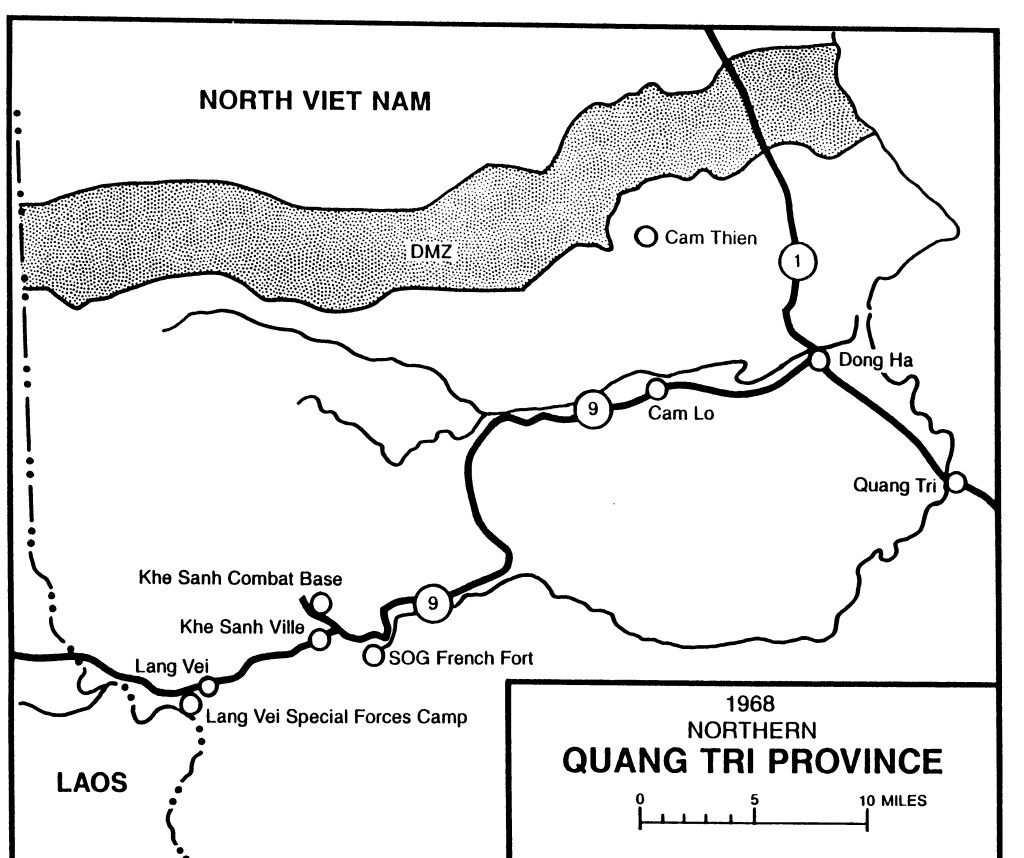
Quang Tri Province bordered North Vietnam and Laos. The western third of the province was Huong Hoa District with a population of about 10,000 (only 1500 Vietnamese in Khe Sanh village and the rest were members of the Montagnard Tribe called the Bru. Over the years they had concentrated along route nine (within 10 kilometers north and south of the route. The area bounded by Lang Vei in the west and big turn in route 9 east of the SOG French Fort in the east.)
The advisory team of 5 soldiers responded to the province advisory team (Advisory Team 4) in Quang Tri. The District Chief Captain Tinh-A-Nhi responded to the province Commander who was a full Colonel in the Army of the Republic of Vietnam (ARVN).
The Special Forces (Special Forces Detachment A-101) at Lang Vei along the border with Laos reported to a C Team headquartered in Hue Phu Bai, which in return reported to the 5th Special Forces Group in Danang.
In the village headquarters was the headquarters of a Combined Action Company (CAC-O) and one Combined Action Platoon (CAP O-1) of 10 Marines and about 25 Montagnards. There was a second such platoon about 200 yards west of the District Headquarters blocking rout 9 from the west. The CAC reported to Colonel David Lounds the KSCB Commander but also had a battalion headquarters in Danang.
Located as an appendage on the western edge of the KSCB there was a special forces Forward Operating Base (FOB-3). The men of FOB-3 with their Montagnard soldiers (mostly Nungs) conducted reconnaissance and raids in North Vietnam and Laos. They reported to a Battalion commander in Hue Phu Bai and Military Assistance Command Vietnam Studies and Observation Group (MACVSOG or SOG) in Saigon.
Finally there was a two man intelligence team located in the village headquarters that reported to a headquarters in Danang. It’s head was LT Jamie Taronji. This two man team had a separate tent and did not mingle with any of the other occupants of the compound. They co-located into the District command post during the fight , but were invisible to us at the time.
Colonel David Lounds as the senior American officer in the Khe Sanh Area of Operations (AO) exercised very loose operational control over the units in the area. All the units would go to the Marines at the combat base for support, but when that support was not forthcoming they would go to their parent units. This was especially true for the Special Forces and Advisory team.
The relations between the Army units—special forces and advisory team—and the Marines were so bad that they had developed their own code terms and frequencies to coordinate with each other so the Marines could not listen in.
Additionally each of the units mentioned had very different missions and therefore different objectives. The lack of unity of command resulted in a loss of unity of effort, which is what the whole concept of unity of command is all about. Unity of effort is supposed to flow from unity of command. All of the units would be working towards a common goal. The Marines goal was to kill NVA. The Advisory Team and District Government’s goal was to provide political leadership for the people of the area and to provide them security from small enemy forces.
A-101’s mission was border surveillance and to block the major avenue of approach into the area—route 9. The SOG team at FOB-3 only staged in Khe Sanh for out of area operations in Laos and North Vietnam. Thus no unity of effort.
This spaghetti bowl of relationships was the situation that existed when the battle of Khe Sanh began on 21 January 1968.
Khe Sanh—the intelligence build up
In the next several days and maybe even weeks, I will share some of the facts and conclusions that I have reached in the 55 years since I was deeply involved in attack on Khe Sanh village and the Vietnamese District Headquarters on the western edge of the village. We will start by laying out the intelligence build up before the battle was joined.
When I wrote my book Expendable Warriors the title was so selected because General Westmoreland and Colonel Lounds at the Khe Sanh Combat Base (KSCB) knew that the North Vietnamese Army was going to attack Khe Sanh as much as 3 months before the attack began. However, the Advisory Team in Khe Sanh village in the District Headquarters was not told. We guess this was because the American leadership feared that the intelligence would be leaked to our Vietnamese counterparts and then get back to the North Vietnamese. What was the intelligence?
The intelligence that the NVA were going to attack Khe Sanh got its first visibility in November 1967 when Colonel Lounds (Commander of the KSCB) told some Marines that: “you will soon be in the American history books.”
Recently unclassified intelligence showed that in October 1967 an NVA Division began moving towards Khe Sanh. There was also information from signal intercepts that a new headquarters had been formed to control a multi-division attack on Khe Sanh.
General Westmoreland’s intelligence brief of 12 January confirmed that the attack would begin on 21 January. During the entire month of January Military Assistance Command Vietnam (MACV) began preparations for the battle of Khe Sanh by:
- Reinforcing the KSCB first on the 13December with an additional Marine Infantry Battalion. The order sending the battalion to KSCB noted that reinforcements should not flow to KSCB too quickly so as to avoid the NVA knowing of General Westmoreland’s intentions.
- An air campaign to target the NVA using B-52s as they approached Khe Sanh was begun on 5 January –Operation Niagara
- Approval to use what was then a classified / controlled fragmentation artillery munition (COFRAM—also known as fire cracker) was sought
- An Air Support Radar Team was deployed to KSCB on 16 January to control radar guided air attacks.
- On 17 January an additional Marine infantry battalion arrived at Khe Sanh bringing the force up to 3 battalions.
- On 18 January sensors were diverted from the Ho Chi Minh trail in Laos and deployed around the KSCB to monitor the movement of the NVA into the area.
During the period beginning in December 1967 the Marines at KSCB began improving their defensive positions by digging deeper putting up more sand bag reinforced bunkers. Ammunition resupply by air began in earnest. This Marine effort was intelligence to those of us on the Advisory Team in the District Headquarters. We began to take similar actions by improving the defenses of our little compound.
Finally on 19 January an NVA officer was captured performing a reconnaissance of the wire surrounding the KSCB. This officer had the entire plan for the attack from the northern Division (NVA Division 325 C) that was to attack KSCB beginning on 21 January.
The information on the pending attack was known to the leadership at Khe Sanh and throughout the relevant portions of MACV, BUT not in the District Headquarters. The scene was set for the events of the next almost 80 days.
World War II+: A proxy war?
After listening to Ukraine President Zelensky last night and watching him and President Biden gush over each other at their press conference I am convinced that the Biden administration feels that they are fighting and winning a proxy war against Russia and that this will make up for the disaster that was Afghanistan.
The resources to support Ukraine are approaching $120B. Biden went out of his way to say that the Patriot Battery that is going to Ukraine is defensive in nature. An argument which might be true in that the Patriot missiles only engage air targets and thus are defending against those targets. However when one digs a little deeper into the upcoming Patriot deployment the escalation becomes readily apparent. The system has a range of 100 KM which, depending upon where located could reach out and cover part of the Russian air space. One battery will protect a small (relatively) area—Kyiv for example. Once deployed the battery will become a prime target for Russian cruise missiles and will thus require short range defenses of its own. Why shoot a $3.5 M missile at a $30K cruise missile, if you could detect it?
The biggest escalation that is suggested by the Patriot deployment is the requirement to deploy US troops and/or technicians for an extended period to train the Ukrainians and maintain the system. (It takes over a year to train Patriot crew members and maintenance personnel can take longer. Either the missiles won’t be deployed in the next 12 months, or they will go to Poland or somewhere nearby-Poland? Or US personnel will be placed at risk in Ukraine. The last two of these options are clearly escalatory.
At the same time the Germans and Moroccans are providing tanks to Ukraine. The US is to begin training Ukrainian battalions in Germany—most likely combined arms training at Hohenfels. The Russians, of course, are not sitting still. The are refurbishing older tanks. They are drafting at least 300.000 new conscripts that will be the cannon fodder for this coming Spring’s battles. These new formations will be supported by Iranian built drones and possibly Chinese weapons and ammunition.
The war is not any where near over! But how long can Ukraine’s manpower continue to fight? There are about 460,000 men who reach military age each year. The Ukrainian losses would seem to support an indefinite war, but…..
The most worrisome aspect of the continuing gradual escalation of the war is how the conflict can terminate. Zelensky said last night that there was a huge desire for revenge on the part of the Ukrainian people and therefore a compromise with the Russians is not likely. Of course, this suggests, in addition to leveling the cities and their power and utility systems, the Russians may have to do something else to overcome the Ukrainian will to resist. Huge battlefield victories are not likely. The path to nuclear weapons becomes much more evident in this scenario. Can the US, France and Great Britain continue to deter Russia? (Readers should review my previous article “Will Russia us nuclear weapons over Ukraine?” Or can a stalemate or continued small Ukrainian victories result in a putsch in Russia. And MOST IMPORTANTLY would a putsch result in a less bellicose Russian leadership? There are many Russian generals who enjoy the power and life style that Putin has allowed them in exchange for their support. How easy would it be for them to be convinced to give that life style up?
The uncertainty involved in finding a route to conflict termination suggests that this war can only escalate to reach a termination point where one side or the other says it has had enough. The Biden administration is betting that its support of Ukraine will cause such a termination point to be reached sooner rather than later and the cold war like deterrence of the use of nuclear weapons will carry the day. The administration then will try to make themselves out to be the heroes of the post-World War II era. It defeated the Russian bear more dramatically than did Ronald Reagan. This will then be played to justify all of the leftist social and economic agenda items. They will argue that they know best—see we destroyed the Russian bear without using US military forces.
This is a scary scenario for me to present at this time of the year and I look forward to an active discussion.
Merry Christmas and Chanukah to all and may we all have a prosperous and happy New Year.
Will Russia use nuclear weapons over Ukraine?
In the past several months I have written much about the war in Ukraine. Since then, the Ukraine’s masterful use of NATO supplied precision munitions (especially US supplied HIMARS missile systems) and their own ability to deceive the Russians as to their intent on the ground have resulted in significant tactical victories in several distinct areas of Ukraine. These successes have caused Putin to make veiled threats about the use of nuclear weapons. Many in Washington and elsewhere are voicing concern over these threats. Iodine pills to treat against radiation poisoning have been procured by the US and several NATO allies. The real question is why should Putin use nuclear weapons? Does their use prevent a defeat? Can their use lead to negotiations? Is there a strategic advantage to be gained?
Defeat Prevention
Biden argues that Putin is irrational, a madman of sorts, pressed into a corner facing imminent defeat in Ukraine—and, with that, the likelihood of regime change. But nothing could be further from the truth. Putin is not facing “defeat” in the Ukraine. Defeat implies the end of the Russian Bear as a threat to the rest of Europe. The tactical loses and the demonstration of the technical failures of Russian weaponry does more to demonstrate that Russia is not the 10 feet tall that we used to think that the Soviets were. This week’s news is on the Russian use of Iranian drones to attack Kiev due to the lack of weapons of their own and closed production facilities. T 62 mid cold war tanks are now being refurbished as crews are are being created through forced mobilization throughout Russia. Are these the signs of a huge threat? Putin can retreat to stable pre-invasion lines in the Donbas and elsewhere with little more than egg on his face—nothing close to defeat. However nuclear weapons would change the equation.
Some argue that the face of defeat would be regime change resulting from a defeat in the Ukraine or as a result of the catastrophic reaction to the use of nuclear weapons. Putin owes nothing to whatever Russian public opinion exists around him, and his pals in power, the so-called oligarchs, have (minus a yacht or two) plundered mightily off sanctions. The Russian people have not been allowed to forget their own sacrifices of World War II and have a defense of the motherland drilled into them from birth.
The primary reason for Putin to avoid a nuclear escalation is that it would bring the US and / or some subset of NATO “boots on the ground” deeper into the Ukrainian war zone, and this is something Putin would fear. Indeed, depending on how much force is applied, it could lead to a full-on “defeat” in Ukraine. One is reminded of General (ret) Petraeus’s suggestion that almost in an afternoon the Russian Black Sea fleet and forces on the ground in Western Russia could be destroyed by conventional weaponry, as the Ukrainians are now demonstrating on a relatively small scale.
The U.S. and NATO have been preparing to fight Russia on the plains of Ukraine for some 70 years. In such a short war endless U.S. precision air and missile strikes into those long Russian columns or massed supply bases would destroy the Russian forces in the western areas abutting Ukraine and its neighbors. The last thing Putin should want is to engage NATO directly over chunks of the Ukraine, instead of fighting the current weaker opponent (Ukraine).
Nuclear weapon use leading to negotiations
Through either tactical use against a massed military target, destroying a city like Kiev, an attempt to decapitate the Ukrainian leadership, or a demonstration nuke– sea-level low-yield blast outside Odessa designed to rattle the windows, maybe shut off the lights, but otherwise cause little damage. Each of these are strikes to demonstrate resolve and thus might lead to negotiations. However, almost all of the same effects could be caused by conventional weaponry.
Obviously, the Ukrainians are not presenting massed targets or the Russians cannot detect them and engage them in a timely manner. Nuclear weapon use does not overcome the target acquisition failures of the Russians. Why would the Russians want to contaminate an area that they want to capture?
The current drone strikes against urban sites must be seeking to undermine the Ukrainian people’s resolve to resist Russian aggression leading them to call for negotiations. One only need to remember the anti-war movement in this country causing LBJ to seek negotiations with North Vietnam. Would the Russians want to worry about the world outcry over a city’s destruction by nuclear weapons? The vote of condemnation against Russia in the UN over its invasion of Ukraine had 35 nations abstaining and 5 voting against the motion. Does Putin want to risk that support?
A decapitation strike against the Ukrainian leadership could in fact be counter-productive. In addition to probably destroying an urban area the leadership that is waiting in the wings could be even more hawkish with their demands for revenge. In short, a total backfire against the sought-after goal of negotiations.
A demonstration strike might raise fears among the faint hearted, but more likely would be cause for the Petraeus conventional attacks.
In short, a nuclear strike is highly unlikely to result in negotiations.
Strategic advantage to be gained by the use of nuclear weapons?
The short answer is NO! The above discussion shows that there is nothing to be gained by the use of nuclear weapons. EXCEPT the fear quotient that has been voiced by leaders in many western capitals in response to the threats of their use. To the extent that these leaders have displayed weakness in the face of these veiled threats they have provided the Russians some leverage. How much is problematic. The fear that has caused folks like Elon Musk to support meeting some Russian demands in exchange for negotiations is demonstrative of this point.
This whole discussion suggests that there is a need to find a way to terminate the Russia Ukraine conflict. Nuclear weapons are not the answer! A long cold winter may lessen Western European resolve, but the Russian Expeditionary Force could dissolve. Potentially, it will take the cold European winter to test resolve. It may be that the Russians simply melt back into mother Russia and begin the long rebuilding process in doctrine and weaponry for Russia to re-emerge as a non-nuclear military power on the world stage. Think about how Generals Abrams and DePuy rebuilt the US Army after Vietnam.
US-China Relations After the Pelosi Visit to Taiwan:
US China relations have moved to the front page as a result of the Chinese reaction to House Speaker Nancy Pelosi’s bid to Taiwan. There are two intertwined main subjects:
- The threat to Taiwan and what the Chinese reaction to Pelosi’s visit.
- The overall US China relationship
There should be no doubt that the Communist Chinese leadership of the People’s Republic of China (PRC) is angry at the United States, and especially House Speaker Nancy Pelosi, for her visit to Taiwan. And then to add injury to insult there was a follow-on Congressional visit last week. China reacted with a barrage of “signals”. At the center of these signals have been has been extensive military exercises meant to maintain tension on the island and in the surrounding areas. Another has been the cancellation of US-Chinese dialogues, exchanges, and cooperation in selected areas. These include:
Canceling China-U.S. Theater Commanders Talk.
Canceling China-U.S. Defense Policy Coordination Talks (DPCT).
Canceling China-U.S. Military Maritime Consultative Agreement (MMCA) meetings.
Suspending China-U.S. cooperation on the repatriation of illegal immigrants.
Suspending China-U.S. cooperation on legal assistance in criminal matters.
Suspending China-U.S. cooperation against transnational crimes.
Suspending China-U.S. counternarcotics cooperation.
Suspending China-U.S. talks on climate change.
This highlights how the Pelosi visit and US Chinese relations are intertwined. While some see China as over-reacting, probably a better explanation is that it thinks that it can act in a belligerent way and get away with it. For Beijing, Pelosi’s visit was emblematic of all that is going wrong in US-PRC relations. Some analysts suggest that from the Chinese Communist Party’s (CCP) perspective, the trip was a betrayal of the foundations of the US-China rapprochement. Beijing’s willingness to pursue a more harmonious relationship with the U.S. was grounded, in part, in the idea that Washington accepted that the CCP was the legitimate government over all of China.
Over the last several decades American ambivalence and wandering policy—ranging from the formulation of “The US One-China Policy which acknowledges the PRC’s One-China Principle,” to arms sales to Taiwan, to the Taiwan Relations Act—were grudgingly accepted, mainly because China did not have the power to really alter American decisions. But as China’s power has grown and the US’s power is perceived to have been reduced, China now perceives that it can act as if its patience and tolerance of these formulations has dropped. That the United States, with its decline in relative power, still does not align itself with the Chinese order of things makes China behave as if it is infuriated.
Driving this is that the Chinese truly believe that Taiwan belongs, indeed is part of, China. This is not merely the result of CCP propaganda. Chinese nationalism predates the CCP. Chinese claims to Taiwan are linked to the exploitation of China by a variety of states (especially Japan) during the 19th and early 20th century. Taiwan is recognized as an independent state by only a handful of states—and the United States is not among them. For the CCP, but also for Chinese nationalists more broadly, American support for Taiwan is seen as a stalking horse for pushing the fragmentation of China.
This deep suspicion of American intentions is further colored by the ideological concerns of the Chinese Communist Party. Xi Jinping and other Chinese leaders are concerned not only with attacks on China, but on the CCP, including eroding its legitimacy. They view talk of “peaceful evolution” as simply a kinder, gentler way of discussing the fall of the CCP. The 1990s Russian example serves as a stark reminder of what the West would like to happen.
Consequently, the CCP leadership believes that it must make clear, to both Taiwan and the United States, that not only will China not surrender its claim to Taiwan, but that American “meddling” will only have negative consequences. This takes on greater urgency when Beijing sees President Biden repeatedly stating that the United States will come to the aid and defense of Taiwan. The presence of the Speaker of the House in Taipei, when she is third in line of succession, only underscored perceived American intentions.
The Pelosi visit, moreover, occurred at an awkward moment for the Chinese. The Chinese leadership is preparing to adjourn to the resort of Beidaihe to engage in the backroom politics that will be ratified at the Party congress later this fall. A variety of issues are likely to be under discussion, including the ongoing COVID crisis in China (and the associated lockdowns that are unpopular and economically disruptive), the economic slowdown, and ongoing internal unhappiness and unrest.
Taiwan continues to play a key role in the global microchip market, eclipsing China in both volume and quality of its chips. The backwards nature of China’s own microchip capacity has been spotlighted with the apparent reprisals against those associated with Tsinghua Unigroup. Meanwhile, several officials linked with China’s chip infrastructure investment fund, the China Integrated Circuit Industry Investment Fund, are also reportedly under investigation. China’s inability to make substantial gains in semiconductor production means it will remain heavily dependent on Taiwanese manufacturers for advanced logic chips to power its information sector. It is not this anger that should be troubling, however, but the response. Taiwan produces 75% of the chips used in the US. Further interruptions in the flow of chips could do great damage to the US economy. If it were not for China’s dependence on these chips the US could be experiencing this worrisome disruption in chip flow.
Western and Soviet leaders throughout the Cold War worried about misperceptions, miscommunications, and inadvertent conflict. The two sides inaugurated a “hotline” that allowed for communications between the two sides in time of crisis. For both sides, confidence-building measures, exchanges of data, and the creation of communications forums and mechanisms, were in their own self-interest. Recognizing the potential for miscalculation and inadvertent escalation, Soviet (and later Russian) leaders, as well as Western ones saw these systems as helping both sides maintain stability. By contrast, there are no such misperception communication protocols in place and in the near term no prospects for the negotiation of such protocols.
As we look ahead
China’s response to the Pelosi visit included unprecedented missile overflights of Taiwan. Such flights could have gone terribly wrong. Had a missile malfunctioned and landed on Taiwan, the consequences might have been catastrophic. Even worse is that now the Chinese may well consider they have established a precedent for future exercises, suggesting that they may conduct such overflights again in the future. They obviously felt emboldened by the weak US and allied response. The Chinese also do not seem to see a need for stability enhancing protocols.
As noted, and importantly, Beijing has chosen to suspend a variety of dialogues with the United States. Some, such as climate change, are clearly aimed at the Biden administration’s priorities. Given the Biden administration’s emphasis on climate change as the greatest threat confronting the United States and the regular inclusion of climate change in Xi-Biden dialogues (including the one just before the Pelosi visit), Chinese leaders are most likely correct in thinking this is a potentially powerful pressure point against the Biden administration. This obvious misplaced pressure point certainly reduces the US ability to influence China. Was trying to influence China what the 6 million barrel of oil sale was all about?
Similarly, given the opioid crisis in the US, and the reality that China is a major source of fentanyl and associated compounds, curtailing discussions in countering narcotics is another strike against a major issue confronting American leaders. However, a firm and resolute attack on the supply chain from China to the Mexican cartels might have overwhelming advantageous results. But this would mean closing the border.
Three of the eight agreements listed above are military dialogues. These include the Military Maritime Consultative Agreement, which is intended to address incidents at sea, as well as defense ministry talks and discussions between respective military theater commanders. The decision to suspend these talks reflects the CCP view that such interactions, are not of mutual benefit, but are a favor to outsiders. Like Chinese emperors of old, exchanges are not between equals, but a courtesy or indulgence given to reflect favor—or taken away to reflect displeasure.
The combination of both overflights and reduced interactions creates real potential for greater misunderstanding. Indeed, in both cases, missile overflights and suspension of military dialogues, the Chinese logic is strikingly at odds with Western concepts of crisis stability. The PRC seems to believe that crises are, ultimately, under the control of the participants. That a crisis may take on a momentum of its own, apart from the intended actions of the participants, seems to not be of major concern. What would have happened if the Taiwanese had engaged the Chinese air threat or missile threat? Would China have backed down or escalated into true attacks. This question leads to an obvious potential turning point in the situation. If the Taiwanese were to respond massively to such belligerent Chinese actions and launch preemptive attacks on the mainland, could they momentarily disarm the Chinese? Creating such a pause might be what it is required to defuse the situation. Conversely, and extremely worrisome, is the potential global reactions of the Chinese.
The Chinese appear to almost be exploiting Western concerns with the above mentioned intentional or inadvertent escalation and unintended consequences. They seem to have adopted the view that, if their counterparts want more stability and less risk, then they should concede to China. If Taiwan doesn’t want to worry about missile overflights, then it should promptly enter talks about reunification. If the United States doesn’t want to risk inadvertent crises, it should stay out of the western Pacific, halt arms sales to Taiwan, and press Taipei to engage in reunification talks. As the CCP sees it, crisis stability is the problem of the other side. And, of course this is the problem. Weakness, may breed further emboldening of China.
Following the COVID pandemic, when Americans realized that most of the critical drugs to US medical needs are manufactured in China. There are many other items’ supply chains that China can control. Conversely, the Chinese economy is in a down turn and thus showing its vulnerability. Much of this is the result of the Chinese birth control policies that have created a steadily aging population with more retirees and fewer workers. This will take decades to resolve.
The containment policy that was initiated in 1947 and resulted in the collapse of the Soviet Union 45 years later suggests that the long run view adoption of a similar strategy might be successful in a much shorter period of time. Could economic isolation by reducing dependence on Chinese goods accelerate the modification of Chinese behavior? Probably, but US and European dependence on Chinese goods in the short term will be expensive and socially disruptive. So, the conundrum is there, it is visible to those who will look, but solving it the Chinese hope will be too painful.
Taiwan and the US escaped the immediate reaction to the Pelosi visit. But the long-term relationship with China has not returned to normal (whatever that is) and possibly now is the time to adopt a new policy that applies economic containment with relaxation based upon Chinese behavior.
What do you think?

