Home » Articles posted by colonelbruce (Page 2)
Author Archives: colonelbruce
Remarks at Ponte Dirillo–10 July
Ladies and Gentlemen:
80 years ago, to the minute, brave paratroopers of the First Battalion, 505th Parachute Infantry Regiment, who had parachuted into the area just behind the fortifications to our rear, were fighting off German efforts to attack through this very point to destroy the American First Infantry Division which was coming ashore near Gela. These infantrymen were to link up with the paratroopers in the coming days.
Today I join you not only as a former warrior, but as the son of a true warrior (LTC Arthur
F. Gorham) who was leading those paratroopers who were fighting outnumbered and out gunned to safeguard the landings near Gela. My father gave his life while leading his airborne soldiers against this determined foe at the beginning of the effort to rid Italy and Europe of the scourge of Fascism’s two evil dictatorships. His name is at the top of the tablet behind me.
I am again today reminded of a saying that I had to learn while a cadet at West Point that is attributed to General Douglas MacArthur-“There is no substitute for
victory.” The brave men and women from many countries who struggled with the foe
here in Sicily 80 years ago as part of Operation Husky knew what the sweet taste of
victory would be.
The Allied invasion of Sicily, codenamed Operation Husky, was the major World War II
campaign, in which the Allies took Sicily from the Axis (Italy and Nazi Germany). It was a
coordinated large scale amphibious and airborne operation, followed by six weeks of
intense land combat. Husky set the stage for launching the campaign to liberate the rest
of Italy. The lessons learned from Operation Husky made the landings at Normandy possible. It all began right here!
My friend, Senore Ventura, whose farm we are at today, remembers observing as a young boy the fighting and dying that occurred right here where we celebrate the feats of those brave warriors who fought here for freedom. History was made by these brave men. It was the first nighttime mass parachute drop ever. It was the first true test of combined military operations by a military coalition. At midnight on July 9/10, 1943 these men would leap into Sicily totally unaware that scores of German panzers were lurking just inland in the darkness.
For many of the American forces and for the entire Canadian contingent, this was their first time in combat. They learned here what it meant to win on the battlefield against a determined foe.
Today the nature of warfare has changed. It is unclear what constitutes victory in the
current political climate in the eyes of the media. What is the taste of victory? We fight against terrorists who know no rules of war and who want to deny us our freedoms. Very pertinent to today is what Winston Churchill said in 1940 before the United States entered World War II: “Victory at all cost. Victory in spite of all terror. Victory no matter how long and how hard the road may be; for without victory there is no survival.”.
As we contemplate the sacrifices made 80 years ago let us insure that the warriors’, who died freeing the world from Fascism and later communism, lives will continue to be relevant in our search for freedom from the tyranny that terrorists and others would impose on us. We as an international community must remember that for without victory there is no survival. Those brave men and women of 80 years ago understood this–do we?
Let me close by reassuring those who gave their lives for freedom that we understand
their sacrifice by reciting The Absent Legions by – Edgar A. Guest
Somewhere, far away, ‘they heard us
When the word of Victory stirred us.
Safe within God’s Holy keeping,
Heard us cheer and saw us weeping;
Shared in all we did or said-
Freedom’s glorious, youngest dead.
Never doubt it, there was gladness
Where the dead are done with madness,
Hate and hurt, and need for dying.
As they saw our banners flying
On our day of joyous pride,
” ‘Twas for this,” said they,
“We died!”
What if tears our eyes had blinded.
As of them we were reminded?
Never doubt it. they were voicing
Somewhere. songs of great rejoicing;
Glad to look on earth and see
Safe our country. still. and free.
Finally, I want to thank Senore Ventura and all of our Sicilian friends for the warm hospitality extended to my family and all who celebrate freedom. In our 4 visits to this hallowed ground, we have been warmly received and we appreciate the friendship that has not only been developed here but between our two nations.
May God bless the warriors listed on the memorial behind me and all of the warriors who died for freedom and each and every one of us.
Thank you!
Part 7: Art Gorham–The battles near Ponte Dirillo
Part 7 The fight near Ponte Dirillo
Art positioned himself and the few dozen stragglers he found on the high ground near Comico airfield. On July 11, when approximately ten German tanks and a battalion of infantry began to assault their position, and all of his men were lying as low as possible, Art was on his feet, dodging incoming fire and moving around the position, bucking up his outnumbered men. When one of the teams manning a captured anti-tank gun was all wounded or killed, Gorham sprang for the weapon, loaded it himself, and went after one of the tanks. He hit the tank’s vulnerable side, setting it on fire. Art then moved from point-to-point firing into the eye-slit of tanks, shouting encouragement to the men and directing their fire until the counterattack was repulsed. For his actions on July 11, 1943, Gorham was awarded the nation’s second-highest award for bravery, the Distinguished Service Cross.
The next day, July 12, Art and his unit came face to face with another German tank unit near Niscemi, Sicily. William B. Breuer in Drop Zone Sicily describes the action: Art “grabbed a rocket launcher and edged his way within range of a menacing Tiger Tank which had continued to roll forward. Gorham, out in the open and in full view of enemy tankers, kneeled to take aim at the tank. Gunners in the Tiger spotted the parachute leader and fired an 88mm shell at Gorham at point-blank range. Gorham, hardnosed to the end, fell over dead.”
The citation for the Distinguished Service Cross he was awarded for his actions reports: “Lieutenant Colonel Gorham personally manned a rocket launcher and destroyed one tank. While attempting to destroy another with hand grenades and a rifle, Lieutenant Colonel Gorham was killed.” The details of this story were later relayed to Gorham’s family by Chicago Tribune reporter John Hall Thompson in December 1943.
Bill Ryder first reported Art’s death in a March of Time radio broadcast on August 19, 1943. “One of the outstanding examples of heroism was Lt. Col. Arthur Gorham, whose unit was attacked by tanks. When one of his bazooka teams was wiped out by an approaching tank, he manned the weapon himself and got the tank single-handed before being killed himself by another tank on their flank.” Ryder was the first American paratrooper and had jumped with Colonel Gavin in Sicily as an advisor. Ryder would later return Gorham’s personal effects to my mother.
Colonel Gavin was to write to my mother, “Most of the combat success of the Regiment in Sicily was due to Art and the men of his command.” After the war, Gavin, by then a lieutenant general, wrote in his memoir, On to Berlin, “Colonel Gorham and his small group of troopers… accomplished all of the missions assigned to the entire regimental combat team. It was a remarkable performance, and I know of nothing like it that occurred at any time later in the war…His death was a great loss to the division.”
General Ridgway probably put this in the best perspective when he wrote, “The action which resulted in his death was typical of his inspiring leadership, for it was he that personally instilled the spirit of the attack at a time that those around him were thinking only of defense, and in person led the attack, which succeeded. His indomitable spirit acknowledged no odds.”

Plaque Near Ponte Dirillo Ceremony to be here on 10 July 2023

Looking north west from the plaque to the fortification guarding the road
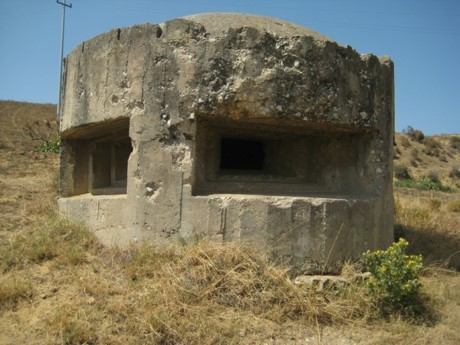
One of the bunkers overwatching Ponte Dirillo
Remarks in Gela 9 July
Ladies and Gentlemen:
Precisely 80 years ago at 8:10 PM the aircraft carrying the paratroopers of the 505th Parachute Infantry Regiment set off from Tunisia. Their mission was to block the roads leading to the landing sites here in Gela to protect the landing forces from attack on their beachheads. One of those paratroopers was my father LTC Arthur F. Gorham.
It is a distinct honor for all of Art Gorham’s descendants to be in Sicily to celebrate his life, his heroism and the heroism of all of the brave soldiers on both sides of the conflict.
History was made by these brave paratroopers. It was the first nighttime mass parachute drop ever. It was the first true test of combined military operations by a military coalition. At
midnight these paratroopers jumped into Sicily totally unaware that scores of
German panzers were lurking just inland in the darkness. This was the beginning of Operation Husky. The allied military operation to liberate Sicily.
Strong winds of up to 45 miles per hour (72 km/h) scattered aircraft widely off course,
and most of the paratroopers failed to reach their rallying points. Those few that did rallied vicinity Ponte Dirillo and in the ensuing days defeated several counterattacks lead by German panzers against the beachhead and thus insured the success of the landings. This small force lead by my father accomplished the Regimental mission and insured that the landings on the beaches near where we are tonight would be successful.
The First Infantry Division (the Big Red One), in which I served twice. Came ashore near where we are tonight and was to link up with the paratroopers as they went on to secure the area around Gela and begin Patton’s steady attacks north on the west side of Sicily, The liberation of Sicily had begun.
My father gave his life while leading his airborne soldiers against a determined
foe at the beginning of the effort to rid Italy and Europe of the scourge of Fascism’s two evil dictatorships. He personally destroyed several German panzers attempting to reach the beaches. For his bravery he was awarded two Distinguished Service Crosses. The Distinguished Service Cross is the second highest award for bravery that the United States military awards.
From Sicily the allied forces who had liberated Sicily were to attack the Italian mainland and a year later came the Normandy invasion. Normandy was possible because of the lessons learned liberating Sicily.
Today the nature of warfare has changed. It is unclear what constitutes victory in the current political climate in the eyes of the media. What is the taste of victory? We fight against foes who know no rules of war and who want to deny us and our allies our freedoms. Very pertinent to today is what Winston Churchill said in 1940 before the United States entered World War II “Victory at all cost. Victory in spite of all terror. Victory no matter how long and how hard the road may be; for without victory there is no survival.”.
As we contemplate the sacrifices made 80 years ago let us insure that those warriors’
lives continue to be relevant in our search for freedom from the tyranny that others would impose on us. We as an international community must remember that for without victory there is no survival. Those brave men and women of 80 years ago understood this-do we?
Let me close by reassuring those who gave their lives for freedom that we understand their sacrifice by reciting The Absent Legions by – Edgar A. Guest
Somewhere, far away, ‘they heard us
When the word of Victory stirred us.
Safe within God’s Holy keeping,
Heard us cheer and saw us weeping;
Shared in all we did or said-
Freedom’s glorious, youngest dead.
Never doubt it, there was gladness
Where the dead are done with madness,
Hate and hurt, and need for dying.
As they saw our banners flying
On our day of joyous pride,
” ‘Twas for this,” said they,
“We died!”.What if tears our eyes had blinded.
As of them we were reminded?
Never doubt it. they were voicing
Somewhere. songs of great rejoicing;
Glad to look on earth and see
Safe our country. still. and free.
Operation Husky–the big picture
The Allied invasion of Sicily, also known as the Battle of Sicily or Operation Husky, was a major campaign of World War II in which the Allied forces invaded the island of Sicily in July 1943 and took it from the Axis powers (Fascist Italy and Nazi Germany). It began with a large amphibious and airborne operation, followed by a six-week land campaign.
Tomorrow marks the beginning of the invasion.
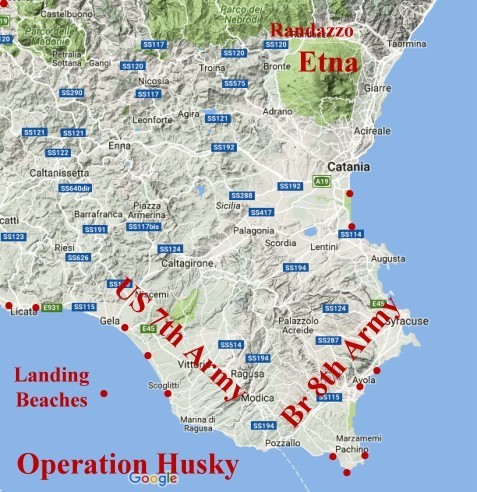
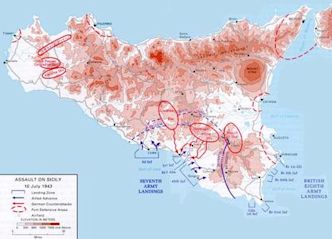
To divert some of the Axis forces to other areas, the Allies engaged in several deception operations. Husky began on the night of 9–10 July 1943 and ended on 17 August. Strategically, Husky achieved the goals set out for it by Allied planners; the Allies drove Axis air, land and naval forces from the island and the Mediterranean Sea lanes were opened for Allied merchant ships for the first time since 1941. These events led to the Italian leader, Benito Mussolini, being toppled from power in Italy on 25 July, and to the Allied invasion of Italy on 3 September.
Strategic Implications
The German leader, Adolf Hitler, “canceled a major offensive at Kursk after only a week, in part to divert forces to Italy,” resulting in a reduction of German strength on the Eastern Front. The collapse of Italy necessitated German troops replacing the Italians in Italy and to a lesser extent the Balkans,
resulting in one-fifth of the entire German army being diverted from the east to southern Europe, a proportion that would remain until near the end of the war. Secondly, without Sicily it is unlikely that Normandy almost a year later would have been possible. The lessons learned about large combined arms operations in Sicily provided great aid to the allied planners and warriors. Many who fought in Sicily went on to the beaches of France.
Part 6: Art Gorham–Off to Sicily
On July 9th, activity was feverish as the soldiers packed their gear and drew ammunition and rations. Tents were struck. Excess gear was turned into the supply sergeants. Dinner was served early that evening, and then the troops were transported to the airfields. Operation Husky was on!
Each member of the Regiment received a slip of paper with the following message from Colonel James Gavin:
Tonight you embark upon a combat mission for which our people and the free people of the world have been waiting for two years.
You will spearhead the landing of an American Force upon the island of Sicily. Every preparation has been made to eliminate the element of chance. You have been given the means to do the job and you are backed by the largest assemblage of air power in the world’s history.
The eyes of the world are upon you. The hopes and prayers of every American go with you.
Since it is our first fight at night you must use the countersign and avoid firing on each other. The bayonet is the night fighter’s best weapon. Conserve your water and ammunition.
The term “American Parachutists” has become synonymous with courage of a high order. Let us carry the fight to the enemy and make American Parachutists feared and respected through all of his ranks. Attack violently. Destroy him wherever found.
I know you will do your job.
Good landing, good fight. And good luck.
- Colonel Gavin
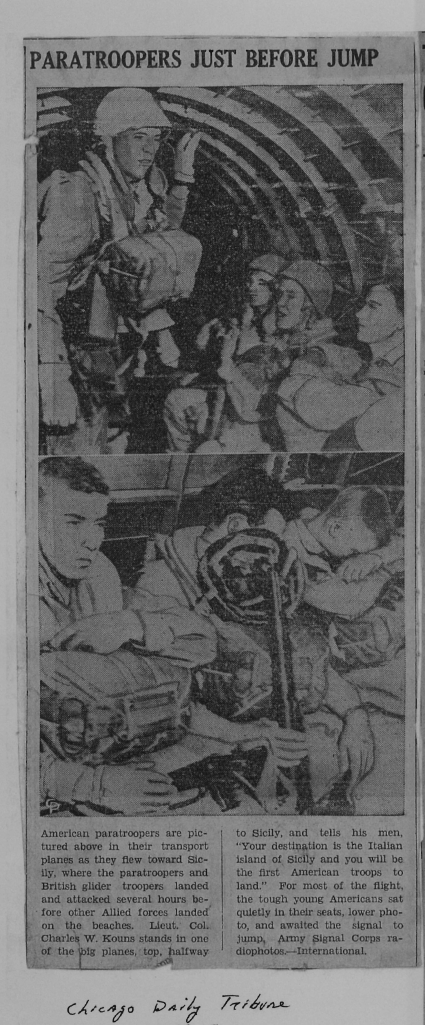
The men finally chuted up, and the planes began to take off. It took an hour and six minutes to get all the aircraft in the air on a route leading to Malta before turning toward Sicily. Everything to that point had gone according to plan. After that, very little went according to plan.
The troop carriers were to fly 200 feet (about 61 meters) above the sea to avoid radar detection. However, a violent wind storm whipped the carrier formations, creating problems as the pilots fought the wind. At such a low level, the pilot feared being thrown into the waves just below their aircraft. The flight crews were navigating by compass and elapsed time. The wind upset the elapsed time measurements and blew the formations off their compass headings. The storm midway on the route became a tailwind, so most pilots overshot their first significant landmark, Malta.
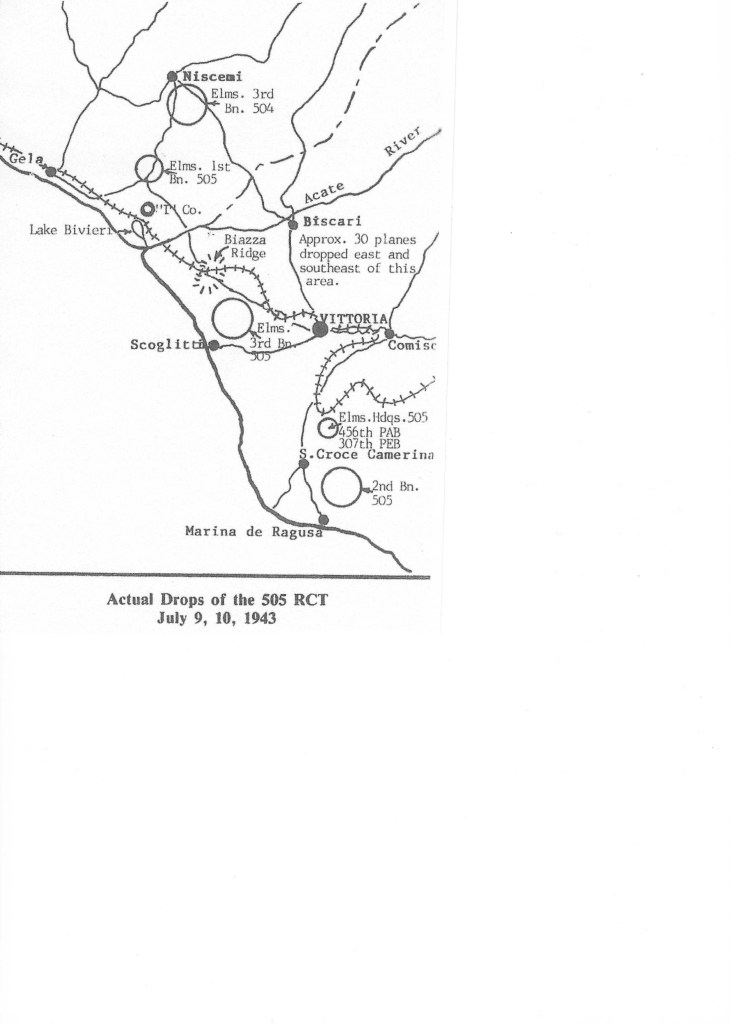
The early hours of the assault to liberate Sicily could have been a disaster. A few planes, either because of luck or superior navigation, managed to drop their sticks of 16 paratroopers within one to three miles of the correct drop zones. Half of A Company of the 1st Battalion, including the battalion command element with Art, were dropped near the Y crossing: the Regiment’s most important objective. The rest of the battalion and Regiment were scattered far from their assigned drop zones. The resulting little groups of paratroopers, as they had been trained, proceeded to attack every German or Italian element that they encountered. This small group of soldiers led by Art Gorham was to accomplish the mission assigned to the entire Regiment.
Preliminary Schedule of events in Sicily 11-13 July
THE PROGRAM OF EVENTS IN SICILY FOR THE 80TH ANNIVERSARY OF OPERATION HUSKY. THE PROGRAM WAS DEVELOPED BY THE ARMY COMMAND IN SICILY TOGETHER WITH THE UNITED STATES AND CANADIAN
| ST. PETER’S CEREMONY LINEUP OF JULY 14, 2023 | |||
| HOUR | SPEAKER | ||
| 7.00 pm | The ____________ referent _______ of the Cultural Association LAMBA DORIA now takes the floor. | ||
| 7.05 pm | We will now proceed to the celebration of the flag-raising ceremony. | ||
| 7.10 pm | A laurel wreath (or pillow of flowers) will now be laid in memory of the fallen. | ||
| 7.15 pm | The names of the fallen will now be read. | ||
| 7.25 pm | The prayer for the fallen will now be read. | ||
| 7.30 pm | The ___________________ Referent of the Cultural Association LAMBA DORIA now takes the floor. | ||
| 7.35 pm | The Mayor of Acate, Dr. Giovanni DI NATALE, now takes the floor | ||
| 7.40 pm | The floor now takes the floor on ………… | ||
| 7.45 pm | The floor now takes the floor on ………… | ||
| 7.50 pm | The following now takes the floor: (Mr. Mayor, Councillor for Culture or other representative of the Municipality of Caltagirone) | ||
| 7.55 pm | The ceremony is over, we thank the civil and military authorities, the combat and weapon associations, including the Bersaglieri Association of Niscemi who have been participating in our events for years and all the kind guests who intervened today, who with their presence have made possible the celebration of this sober but solemn ceremony. | ||
Part 5: Art Gorham– Preparing in North Africa
The training in North Africa was intense and miserable. The ground was extremely rocky and caused numerous injuries during parachute jumps and other training. The heat, flies, and a shortage of water made conditions miserable. In addition to the training and the conditions, the Regiment was visited by numerous dignitaries, including Generals Eisenhower, Patton, and Bradley, as well as French, Spanish, and Moroccan dignitaries. Such visits required spit and polish and usually a parade.
The conditions in North Africa receded as a concern as the Regiment prepared to attack Sicily as part of Operation Husky. The American parachute effort was limited to a Regimental Combat team in size by the number of aircraft available to make the jump. General Ridgeway chose the 505th to make the initial airborne assault (the 504th Parachute Infantry Regiment was to follow the next day, designated as H+1) and attached the 3rd Battalion of the 504th to the 505th for the assault. Additionally, the initial assault was to include an artillery battalion, an engineer battalion, a medical company, and a signal detachment.
The mission was simply described:
- Land during the night of D-1 in an area north and east of Gela and capture and secure the high ground there.
- Disrupt communication and movements of enemy reserves during the night.
- Be attached to the 1st Infantry Division effective H+1 hours on D-day.
- Assist the 1st Infantry Division in capturing and securing the landing field at Ponte Olivio.
The Regiment planned to land in four oval-shaped drop zones on and northeast of Ponte Dirillo. This pattern of drop zones was to create a defense in depth. Any enemy attacking from north-eastern Sicily would have to attack through all four battalions to reach the landing sites near Gela. The critical area within the drop zone was a road intersection that formed a Y. The Y was about seven miles east of Gela. The Y was the critical regimental objective and that of the 1st battalion.

The planned drop zones created a defense in depth to stop any attacks against the beach heads
On the first and second of July, the attack elements were airlifted to airfields of Kairouan in French Tunisia to stage for the upcoming attack. The weather conditions were much improved compared to those they experienced in North Africa, thanks to a cool breeze from the Mediterranean.
The focus changed from training to planning as commanders studied aerial photos of Sicily. On July 6, the men of the Regiment took time off to enjoy some barbecued beef prepared by their cooks and a canteen cup or so of beer, which some industrious supply sergeant had found.
Up to July 8th, the departure date had been a closely held secret, but on that day, the chaplains offered communion to the troops. Chaplain Wood noted that service attendance had been poor in the states, but on the 8th, “attendance was high.”
The stage was now set for the parachute assault on fortress Europe that was to occur on the night of 9 July.
The Wagner Group? A “putsch” gone bad?
The Wagner Group has operated as what is portrayed as an independent arm of Russia for many years. It is the independent nature of the Group’s activities that in some cases given Putting and Russia an ability to claim that it is not involved. A marginal argument, at best, but an argument.
What is the Wagner Group and the source of its power?
Dmitry Utkin, a former Russian Spetznatz Lieutenant Colonel, and financier Yevgeny Prigozhin started the Wagner Group, around 2014, toward the beginning of the Ukraine-Russia conflict on the Crimean Peninsula.
For years, it has been shrouded in secrecy, then infamy, and after the recent 48 hours of confusion and claims of a “rebellion” in Russia, questions about the notorious Wagner Group and the intentions of its leader Yevgeny Prigozhin are the focus of some investigation and some estimated guessing.
The Wagner Group is a private military organization run by an ally of Russian leader Vladimir Putin with tens of thousands of fighters. It has operated in Syria and in various African countries. Earlier this year, the US labeled the group a “significant transnational criminal organization” and levied new sanctions against its senior leadership and Russia. Human rights observers have said they suspect Wagner fighters were linked to the mass killing of people in Mali last year.
There are an estimated 50,000 fighters from the Wagner Group in Ukraine. Around 40,000 of the fighters are believed to be convicts, which could lead to more allegations of human rights abuses. Such mercenaries are technically illegal under Russian law and it has long avoided discussing the use of such fighters.
It is reported to have exploited the natural resources of vulnerable nations in order for the group deal with financial punishments like the US sanctions. However, it is impossible to imagine that the group has mined enough illegal gold to offset its expenditures and paying its former convict warriors.
The Wagner group’s defensive operations in the Ukraine have marked it as one of the best Russian military units. The current rebellion (more on that in subsequent paragraphs) has given the Ukrainian counterattack more promise, though it is difficult to imagine that its loss to the Russian formations will be of such magnitude as to create a significant opportunity for Ukraine. The Russians are fighting a World War 1 type of defense. One that is characterized by significant obstacles and trench lines, which must be breached in depth.
The Wagner Putsch
During the offensive and defensive operations around Bakhmut the Wagner Group bore the brunt of the fighting. During this fighting the complaints from the group were frequent and loud about how it was being denied ammunition and other forms of support. The claim was that the Russian military was getting the priority of support while the group was doing most of the fighting.
Following the end of the battles for Bakhmut the group was pulled out of the fight to enable it to rearm and refit. The claim is that it was at this point that allegedly the Russians attacked several group positions with artillery. Such attacks caused the Group’s head Yevgeny Prigozhin to become quite vocal. His verbal attacks lead Vladimir Putin to brand him as a traitor and to call for his arrest. On Friday evening, Prigozhin sent out an audio message warning of an armed rebellion against Russia’s military leadership after accusing it of deliberately shelling his forces. He claimed his forces would punish Russia’s defense minister and chief of general staff, telling other units to stand down and not offer resistance. “There are 25,000 of us and we are coming to sort things out. … Those who want to join us, it’s time to finish with this mess,” Prigozhin said.
He also published a video on Friday that showed a shattered group of trees and a burning trench, claiming it was a Wagner camp shelled by Russian troops and alleging many Wagner troops were killed.
This sparked what some have called a putsch or a rebellion. In either case the Wagner Group seized two towns and the military headquarters controlling actions in Ukraine. The Wagner Group column was attacked by Russian attack helicopters and a Brigade was activated to defend Moscow.
The Belarus President was able to broker a ceasefire and Putin dropped the treason charges against Prigozhin. In an attempt to disband the Wagner Group Putin gave its members three choices:
- Join the Russian Army
- Go home
- Stay with the Wagner Group
Reportedly, Belarus is building a camp to house the 8-10000 warriors who will follow Prigozhin into exile.
What will come next is uncertain, but some estimates / guestimates are possible:
- The loss of the Wagner Group will not significantly impact Russia’s ability to continue the fight in Ukraine.
- Putin was not overthrown, but there is no doubt that he feels that others will think that he is weakened. This may cause him to tighten the noose on those who would challenge him for power. Conversely, others may be emboldened to threaten or take some form of action against Putin. The possibility of some turbulence in Moscow is therefore likely.
- Given Moscow’s reliance on the Wagner Group to support its actions in Syria and parts of Africa the Group will continue, though probably with lessened financial support from Moscow. This will cause it to go “looking” for fund sources, which could be destabilizing.
- In addition to the Belarus President’s intervention, it is the above foreign entanglements that are probably keeping Prigozhin alive. How long will this last?
The Putsch is over and the Wagner Group is being disarmed, except for personal weapons. The threat of it leading another armed “rebellion” is small but this is not to say that another frustrated group may emerge. We can only watch and wait.
Part 4: Art Gorham: 505th PIR prepares for Deployment
In the summer of 1942, the 505th Parachute Infantry Regiment (PIR) was activated in the tarpaper shack Frying Pan area of Fort Benning, overlooking Lawson Army Airfield. (23 years later his son’s first assignement–Jump School would have him living there in a Bachelor Officer’s (BOQ.)) Art Gorham commanded the 1st Battalion. There was no time lost in getting a demanding training schedule started. According to his headquarters company commander of the time, Captain Walt Winton (later to retire as a Brigadier General and my godfather), Art sweated with the rest of the battalion. The regiment subsequently moved across the Chattahoochee River to the Alabama Parachute Training Area, where the beat went on.
Art was promoted to lieutenant colonel (abbreviated as LTC) in December 1942. At the time, he was one of the youngest lieutenant colonels in the Army.

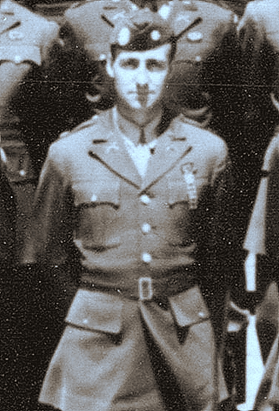
Lieutenant Colonel Arthur F. Gorham
Before the Regiment moved to Fort Bragg, North Carolina, LTC and Mrs. Gorham were joined by a son Bruce Bennett Gorham on January 26, 1943.

LTC Gorham holds young Bruce
When the 505th Parachute Infantry Regiment arrived at Fort Bragg, it joined the 82nd Airborne Division, commanded by Major General Mathew Ridgeway. Training at Fort Bragg evolved from teams and squads to platoons and companies and eventually as larger formations—part of the battalion, regimental and divisional team. The Regiment was to make the first regimental mass parachute jump when it jumped into Fort Jackson, South Carolina, under the watchful eyes of Sir Winston Churchill, Field Marshall Sir John Dill, and General George C. Marshall.

LTC and Mrs. Gorham’s quarters at Fort Bragg
After this mass jump at Fort Jackson, it was determined that the 82nd Airborne Division was better prepared for combat than the 101st Airborne Division. The Division was alerted for deployment overseas. During this time frame the Gorham’s opened their quarters to all of the married officers and their wives so that the couple could spend the last time before deployment together. (The post had been locked down and civilians could not enter it.) Many of these officers mentioned how wonderful such generosity was many years after the fact.
In mid-April 1943, the Division moved from Fort Bragg to Camp Edwards, Massachusetts, under a security blackout. Ten days later, the Division boarded the USS Monterey for the 12-day crossing of the Atlantic Ocean. The Division landed near Casablanca in North Africa. Subsequently, it moved to Oujda, French Morocco
Part 3: Art Gorham–Joining the Airborne
After less than two years at the Presidio, Lieutenant and Mrs. Gorham moved to Fort Benning, Georgia. In November 1941, Art graduated from the newly created Airborne School, receiving a “Certificate of Proficiency” signed by then-Major Robert Sink and, more importantly, a set of silver jump wings. A month later, he completed the School’s demolition and sabotage course. Viewers of “Band of Brothers” may recall Colonel Sink from his exploits leading a regiment of the 101st Airborne Division during World War II.
After graduating from Airborne School, the young officer began to stand out in his short career. As one of the early airborne qualified officers, Art gained more rank and responsibility as the United States began to form parachute regiments and later airborne divisions.
In February 1942, Captain Gorham took his B Company, 504th Parachute Infantry, to Alta, Utah,
where the United States tested the concept of dropping paratroopers into the Alps behind the Germans and having them ski down to attack and harass their lines of communication. The troopers trained hard, but falling on skis was different than falling when landing in a parachute jump. The media played up the idea of para skiers, and Art Gorham’s picture on skis was on the front page of many newspapers. Unreported was the fact that many legs and ankles were injured during the training.
The para skier experiment received widespread news coverage. History has not reported whether Germans increased their rear area security based upon the possible threat that these para skiers represented, but discretion would justify such a diversion of combat forces.
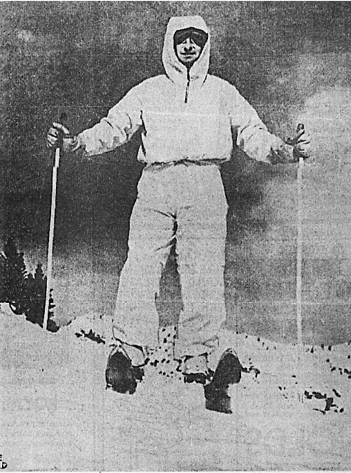
Captain Gorham leads the paraskiers
Eventually, the project was abandoned, and the troopers were spread out to the newly-forming parachute units. The Germans, however, were keenly aware of the threat of the para skiers, which caused them to divert combat forces to protect their logistics lines through the Alps.

