Home » 2023 (Page 4)
Yearly Archives: 2023
Command and Control in the Khe Sanh Area of Operations
We are approaching the 55th anniversary of the Siege of the Khe Sanh Combat Base (KSCB). For the reader, to appreciate what has and is being presented, he needs to understand the very confused and dysfunctional command and control relationships that existed in the Khe Sanh Area of Operations (AOO). There were at least 5 different higher headquarters issuing orders and taking actions that affected what happened.
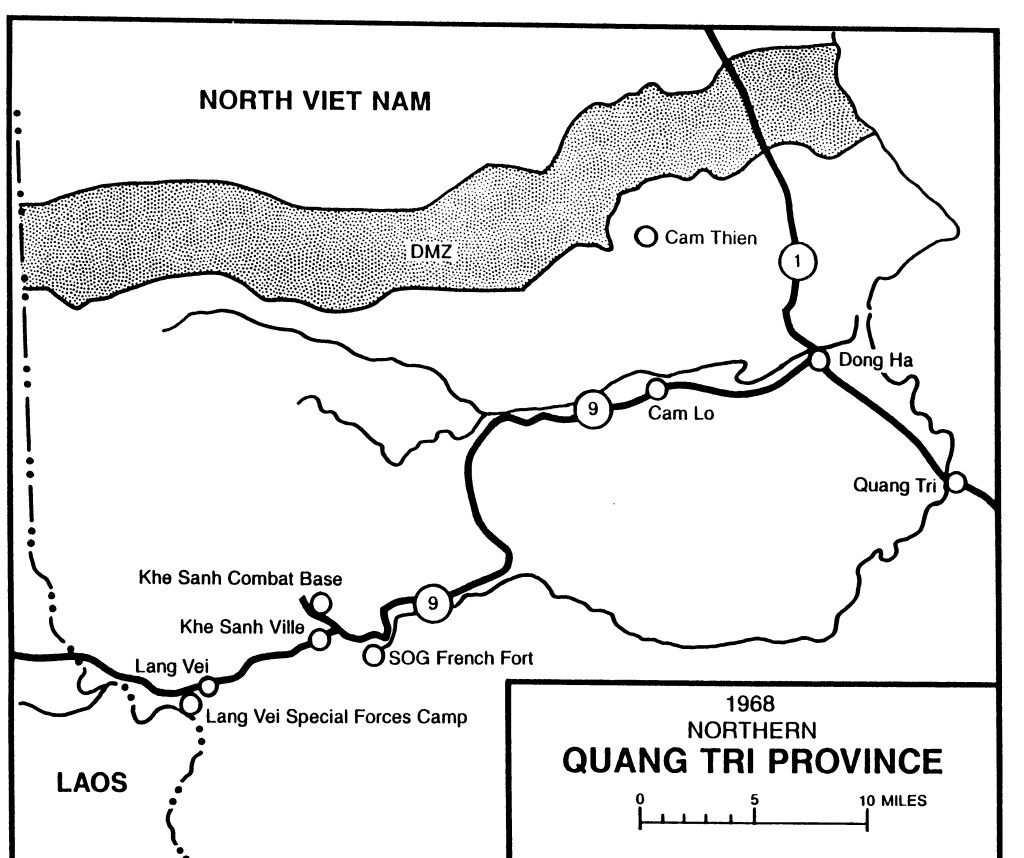
Quang Tri Province bordered North Vietnam and Laos. The western third of the province was Huong Hoa District with a population of about 10,000 (only 1500 Vietnamese in Khe Sanh village and the rest were members of the Montagnard Tribe called the Bru. Over the years they had concentrated along route nine (within 10 kilometers north and south of the route. The area bounded by Lang Vei in the west and big turn in route 9 east of the SOG French Fort in the east.)
The advisory team of 5 soldiers responded to the province advisory team (Advisory Team 4) in Quang Tri. The District Chief Captain Tinh-A-Nhi responded to the province Commander who was a full Colonel in the Army of the Republic of Vietnam (ARVN).
The Special Forces (Special Forces Detachment A-101) at Lang Vei along the border with Laos reported to a C Team headquartered in Hue Phu Bai, which in return reported to the 5th Special Forces Group in Danang.
In the village headquarters was the headquarters of a Combined Action Company (CAC-O) and one Combined Action Platoon (CAP O-1) of 10 Marines and about 25 Montagnards. There was a second such platoon about 200 yards west of the District Headquarters blocking rout 9 from the west. The CAC reported to Colonel David Lounds the KSCB Commander but also had a battalion headquarters in Danang.
Located as an appendage on the western edge of the KSCB there was a special forces Forward Operating Base (FOB-3). The men of FOB-3 with their Montagnard soldiers (mostly Nungs) conducted reconnaissance and raids in North Vietnam and Laos. They reported to a Battalion commander in Hue Phu Bai and Military Assistance Command Vietnam Studies and Observation Group (MACVSOG or SOG) in Saigon.
Finally there was a two man intelligence team located in the village headquarters that reported to a headquarters in Danang. It’s head was LT Jamie Taronji. This two man team had a separate tent and did not mingle with any of the other occupants of the compound. They co-located into the District command post during the fight , but were invisible to us at the time.
Colonel David Lounds as the senior American officer in the Khe Sanh Area of Operations (AO) exercised very loose operational control over the units in the area. All the units would go to the Marines at the combat base for support, but when that support was not forthcoming they would go to their parent units. This was especially true for the Special Forces and Advisory team.
The relations between the Army units—special forces and advisory team—and the Marines were so bad that they had developed their own code terms and frequencies to coordinate with each other so the Marines could not listen in.
Additionally each of the units mentioned had very different missions and therefore different objectives. The lack of unity of command resulted in a loss of unity of effort, which is what the whole concept of unity of command is all about. Unity of effort is supposed to flow from unity of command. All of the units would be working towards a common goal. The Marines goal was to kill NVA. The Advisory Team and District Government’s goal was to provide political leadership for the people of the area and to provide them security from small enemy forces.
A-101’s mission was border surveillance and to block the major avenue of approach into the area—route 9. The SOG team at FOB-3 only staged in Khe Sanh for out of area operations in Laos and North Vietnam. Thus no unity of effort.
This spaghetti bowl of relationships was the situation that existed when the battle of Khe Sanh began on 21 January 1968.
Khe Sanh—the intelligence build up
In the next several days and maybe even weeks, I will share some of the facts and conclusions that I have reached in the 55 years since I was deeply involved in attack on Khe Sanh village and the Vietnamese District Headquarters on the western edge of the village. We will start by laying out the intelligence build up before the battle was joined.
When I wrote my book Expendable Warriors the title was so selected because General Westmoreland and Colonel Lounds at the Khe Sanh Combat Base (KSCB) knew that the North Vietnamese Army was going to attack Khe Sanh as much as 3 months before the attack began. However, the Advisory Team in Khe Sanh village in the District Headquarters was not told. We guess this was because the American leadership feared that the intelligence would be leaked to our Vietnamese counterparts and then get back to the North Vietnamese. What was the intelligence?
The intelligence that the NVA were going to attack Khe Sanh got its first visibility in November 1967 when Colonel Lounds (Commander of the KSCB) told some Marines that: “you will soon be in the American history books.”
Recently unclassified intelligence showed that in October 1967 an NVA Division began moving towards Khe Sanh. There was also information from signal intercepts that a new headquarters had been formed to control a multi-division attack on Khe Sanh.
General Westmoreland’s intelligence brief of 12 January confirmed that the attack would begin on 21 January. During the entire month of January Military Assistance Command Vietnam (MACV) began preparations for the battle of Khe Sanh by:
- Reinforcing the KSCB first on the 13December with an additional Marine Infantry Battalion. The order sending the battalion to KSCB noted that reinforcements should not flow to KSCB too quickly so as to avoid the NVA knowing of General Westmoreland’s intentions.
- An air campaign to target the NVA using B-52s as they approached Khe Sanh was begun on 5 January –Operation Niagara
- Approval to use what was then a classified / controlled fragmentation artillery munition (COFRAM—also known as fire cracker) was sought
- An Air Support Radar Team was deployed to KSCB on 16 January to control radar guided air attacks.
- On 17 January an additional Marine infantry battalion arrived at Khe Sanh bringing the force up to 3 battalions.
- On 18 January sensors were diverted from the Ho Chi Minh trail in Laos and deployed around the KSCB to monitor the movement of the NVA into the area.
During the period beginning in December 1967 the Marines at KSCB began improving their defensive positions by digging deeper putting up more sand bag reinforced bunkers. Ammunition resupply by air began in earnest. This Marine effort was intelligence to those of us on the Advisory Team in the District Headquarters. We began to take similar actions by improving the defenses of our little compound.
Finally on 19 January an NVA officer was captured performing a reconnaissance of the wire surrounding the KSCB. This officer had the entire plan for the attack from the northern Division (NVA Division 325 C) that was to attack KSCB beginning on 21 January.
The information on the pending attack was known to the leadership at Khe Sanh and throughout the relevant portions of MACV, BUT not in the District Headquarters. The scene was set for the events of the next almost 80 days.
 Bruce B.G. Clarke