Home » 2023 (Page 2)
Yearly Archives: 2023
Preliminary Schedule of events in Sicily 11-13 July
THE PROGRAM OF EVENTS IN SICILY FOR THE 80TH ANNIVERSARY OF OPERATION HUSKY. THE PROGRAM WAS DEVELOPED BY THE ARMY COMMAND IN SICILY TOGETHER WITH THE UNITED STATES AND CANADIAN
| ST. PETER’S CEREMONY LINEUP OF JULY 14, 2023 | |||
| HOUR | SPEAKER | ||
| 7.00 pm | The ____________ referent _______ of the Cultural Association LAMBA DORIA now takes the floor. | ||
| 7.05 pm | We will now proceed to the celebration of the flag-raising ceremony. | ||
| 7.10 pm | A laurel wreath (or pillow of flowers) will now be laid in memory of the fallen. | ||
| 7.15 pm | The names of the fallen will now be read. | ||
| 7.25 pm | The prayer for the fallen will now be read. | ||
| 7.30 pm | The ___________________ Referent of the Cultural Association LAMBA DORIA now takes the floor. | ||
| 7.35 pm | The Mayor of Acate, Dr. Giovanni DI NATALE, now takes the floor | ||
| 7.40 pm | The floor now takes the floor on ………… | ||
| 7.45 pm | The floor now takes the floor on ………… | ||
| 7.50 pm | The following now takes the floor: (Mr. Mayor, Councillor for Culture or other representative of the Municipality of Caltagirone) | ||
| 7.55 pm | The ceremony is over, we thank the civil and military authorities, the combat and weapon associations, including the Bersaglieri Association of Niscemi who have been participating in our events for years and all the kind guests who intervened today, who with their presence have made possible the celebration of this sober but solemn ceremony. | ||
Part 5: Art Gorham– Preparing in North Africa
The training in North Africa was intense and miserable. The ground was extremely rocky and caused numerous injuries during parachute jumps and other training. The heat, flies, and a shortage of water made conditions miserable. In addition to the training and the conditions, the Regiment was visited by numerous dignitaries, including Generals Eisenhower, Patton, and Bradley, as well as French, Spanish, and Moroccan dignitaries. Such visits required spit and polish and usually a parade.
The conditions in North Africa receded as a concern as the Regiment prepared to attack Sicily as part of Operation Husky. The American parachute effort was limited to a Regimental Combat team in size by the number of aircraft available to make the jump. General Ridgeway chose the 505th to make the initial airborne assault (the 504th Parachute Infantry Regiment was to follow the next day, designated as H+1) and attached the 3rd Battalion of the 504th to the 505th for the assault. Additionally, the initial assault was to include an artillery battalion, an engineer battalion, a medical company, and a signal detachment.
The mission was simply described:
- Land during the night of D-1 in an area north and east of Gela and capture and secure the high ground there.
- Disrupt communication and movements of enemy reserves during the night.
- Be attached to the 1st Infantry Division effective H+1 hours on D-day.
- Assist the 1st Infantry Division in capturing and securing the landing field at Ponte Olivio.
The Regiment planned to land in four oval-shaped drop zones on and northeast of Ponte Dirillo. This pattern of drop zones was to create a defense in depth. Any enemy attacking from north-eastern Sicily would have to attack through all four battalions to reach the landing sites near Gela. The critical area within the drop zone was a road intersection that formed a Y. The Y was about seven miles east of Gela. The Y was the critical regimental objective and that of the 1st battalion.

The planned drop zones created a defense in depth to stop any attacks against the beach heads
On the first and second of July, the attack elements were airlifted to airfields of Kairouan in French Tunisia to stage for the upcoming attack. The weather conditions were much improved compared to those they experienced in North Africa, thanks to a cool breeze from the Mediterranean.
The focus changed from training to planning as commanders studied aerial photos of Sicily. On July 6, the men of the Regiment took time off to enjoy some barbecued beef prepared by their cooks and a canteen cup or so of beer, which some industrious supply sergeant had found.
Up to July 8th, the departure date had been a closely held secret, but on that day, the chaplains offered communion to the troops. Chaplain Wood noted that service attendance had been poor in the states, but on the 8th, “attendance was high.”
The stage was now set for the parachute assault on fortress Europe that was to occur on the night of 9 July.
The Wagner Group? A “putsch” gone bad?
The Wagner Group has operated as what is portrayed as an independent arm of Russia for many years. It is the independent nature of the Group’s activities that in some cases given Putting and Russia an ability to claim that it is not involved. A marginal argument, at best, but an argument.
What is the Wagner Group and the source of its power?
Dmitry Utkin, a former Russian Spetznatz Lieutenant Colonel, and financier Yevgeny Prigozhin started the Wagner Group, around 2014, toward the beginning of the Ukraine-Russia conflict on the Crimean Peninsula.
For years, it has been shrouded in secrecy, then infamy, and after the recent 48 hours of confusion and claims of a “rebellion” in Russia, questions about the notorious Wagner Group and the intentions of its leader Yevgeny Prigozhin are the focus of some investigation and some estimated guessing.
The Wagner Group is a private military organization run by an ally of Russian leader Vladimir Putin with tens of thousands of fighters. It has operated in Syria and in various African countries. Earlier this year, the US labeled the group a “significant transnational criminal organization” and levied new sanctions against its senior leadership and Russia. Human rights observers have said they suspect Wagner fighters were linked to the mass killing of people in Mali last year.
There are an estimated 50,000 fighters from the Wagner Group in Ukraine. Around 40,000 of the fighters are believed to be convicts, which could lead to more allegations of human rights abuses. Such mercenaries are technically illegal under Russian law and it has long avoided discussing the use of such fighters.
It is reported to have exploited the natural resources of vulnerable nations in order for the group deal with financial punishments like the US sanctions. However, it is impossible to imagine that the group has mined enough illegal gold to offset its expenditures and paying its former convict warriors.
The Wagner group’s defensive operations in the Ukraine have marked it as one of the best Russian military units. The current rebellion (more on that in subsequent paragraphs) has given the Ukrainian counterattack more promise, though it is difficult to imagine that its loss to the Russian formations will be of such magnitude as to create a significant opportunity for Ukraine. The Russians are fighting a World War 1 type of defense. One that is characterized by significant obstacles and trench lines, which must be breached in depth.
The Wagner Putsch
During the offensive and defensive operations around Bakhmut the Wagner Group bore the brunt of the fighting. During this fighting the complaints from the group were frequent and loud about how it was being denied ammunition and other forms of support. The claim was that the Russian military was getting the priority of support while the group was doing most of the fighting.
Following the end of the battles for Bakhmut the group was pulled out of the fight to enable it to rearm and refit. The claim is that it was at this point that allegedly the Russians attacked several group positions with artillery. Such attacks caused the Group’s head Yevgeny Prigozhin to become quite vocal. His verbal attacks lead Vladimir Putin to brand him as a traitor and to call for his arrest. On Friday evening, Prigozhin sent out an audio message warning of an armed rebellion against Russia’s military leadership after accusing it of deliberately shelling his forces. He claimed his forces would punish Russia’s defense minister and chief of general staff, telling other units to stand down and not offer resistance. “There are 25,000 of us and we are coming to sort things out. … Those who want to join us, it’s time to finish with this mess,” Prigozhin said.
He also published a video on Friday that showed a shattered group of trees and a burning trench, claiming it was a Wagner camp shelled by Russian troops and alleging many Wagner troops were killed.
This sparked what some have called a putsch or a rebellion. In either case the Wagner Group seized two towns and the military headquarters controlling actions in Ukraine. The Wagner Group column was attacked by Russian attack helicopters and a Brigade was activated to defend Moscow.
The Belarus President was able to broker a ceasefire and Putin dropped the treason charges against Prigozhin. In an attempt to disband the Wagner Group Putin gave its members three choices:
- Join the Russian Army
- Go home
- Stay with the Wagner Group
Reportedly, Belarus is building a camp to house the 8-10000 warriors who will follow Prigozhin into exile.
What will come next is uncertain, but some estimates / guestimates are possible:
- The loss of the Wagner Group will not significantly impact Russia’s ability to continue the fight in Ukraine.
- Putin was not overthrown, but there is no doubt that he feels that others will think that he is weakened. This may cause him to tighten the noose on those who would challenge him for power. Conversely, others may be emboldened to threaten or take some form of action against Putin. The possibility of some turbulence in Moscow is therefore likely.
- Given Moscow’s reliance on the Wagner Group to support its actions in Syria and parts of Africa the Group will continue, though probably with lessened financial support from Moscow. This will cause it to go “looking” for fund sources, which could be destabilizing.
- In addition to the Belarus President’s intervention, it is the above foreign entanglements that are probably keeping Prigozhin alive. How long will this last?
The Putsch is over and the Wagner Group is being disarmed, except for personal weapons. The threat of it leading another armed “rebellion” is small but this is not to say that another frustrated group may emerge. We can only watch and wait.
Part 4: Art Gorham: 505th PIR prepares for Deployment
In the summer of 1942, the 505th Parachute Infantry Regiment (PIR) was activated in the tarpaper shack Frying Pan area of Fort Benning, overlooking Lawson Army Airfield. (23 years later his son’s first assignement–Jump School would have him living there in a Bachelor Officer’s (BOQ.)) Art Gorham commanded the 1st Battalion. There was no time lost in getting a demanding training schedule started. According to his headquarters company commander of the time, Captain Walt Winton (later to retire as a Brigadier General and my godfather), Art sweated with the rest of the battalion. The regiment subsequently moved across the Chattahoochee River to the Alabama Parachute Training Area, where the beat went on.
Art was promoted to lieutenant colonel (abbreviated as LTC) in December 1942. At the time, he was one of the youngest lieutenant colonels in the Army.

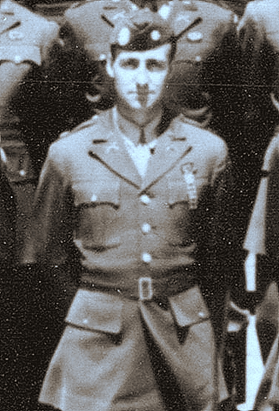
Lieutenant Colonel Arthur F. Gorham
Before the Regiment moved to Fort Bragg, North Carolina, LTC and Mrs. Gorham were joined by a son Bruce Bennett Gorham on January 26, 1943.

LTC Gorham holds young Bruce
When the 505th Parachute Infantry Regiment arrived at Fort Bragg, it joined the 82nd Airborne Division, commanded by Major General Mathew Ridgeway. Training at Fort Bragg evolved from teams and squads to platoons and companies and eventually as larger formations—part of the battalion, regimental and divisional team. The Regiment was to make the first regimental mass parachute jump when it jumped into Fort Jackson, South Carolina, under the watchful eyes of Sir Winston Churchill, Field Marshall Sir John Dill, and General George C. Marshall.

LTC and Mrs. Gorham’s quarters at Fort Bragg
After this mass jump at Fort Jackson, it was determined that the 82nd Airborne Division was better prepared for combat than the 101st Airborne Division. The Division was alerted for deployment overseas. During this time frame the Gorham’s opened their quarters to all of the married officers and their wives so that the couple could spend the last time before deployment together. (The post had been locked down and civilians could not enter it.) Many of these officers mentioned how wonderful such generosity was many years after the fact.
In mid-April 1943, the Division moved from Fort Bragg to Camp Edwards, Massachusetts, under a security blackout. Ten days later, the Division boarded the USS Monterey for the 12-day crossing of the Atlantic Ocean. The Division landed near Casablanca in North Africa. Subsequently, it moved to Oujda, French Morocco
Part 3: Art Gorham–Joining the Airborne
After less than two years at the Presidio, Lieutenant and Mrs. Gorham moved to Fort Benning, Georgia. In November 1941, Art graduated from the newly created Airborne School, receiving a “Certificate of Proficiency” signed by then-Major Robert Sink and, more importantly, a set of silver jump wings. A month later, he completed the School’s demolition and sabotage course. Viewers of “Band of Brothers” may recall Colonel Sink from his exploits leading a regiment of the 101st Airborne Division during World War II.
After graduating from Airborne School, the young officer began to stand out in his short career. As one of the early airborne qualified officers, Art gained more rank and responsibility as the United States began to form parachute regiments and later airborne divisions.
In February 1942, Captain Gorham took his B Company, 504th Parachute Infantry, to Alta, Utah,
where the United States tested the concept of dropping paratroopers into the Alps behind the Germans and having them ski down to attack and harass their lines of communication. The troopers trained hard, but falling on skis was different than falling when landing in a parachute jump. The media played up the idea of para skiers, and Art Gorham’s picture on skis was on the front page of many newspapers. Unreported was the fact that many legs and ankles were injured during the training.
The para skier experiment received widespread news coverage. History has not reported whether Germans increased their rear area security based upon the possible threat that these para skiers represented, but discretion would justify such a diversion of combat forces.
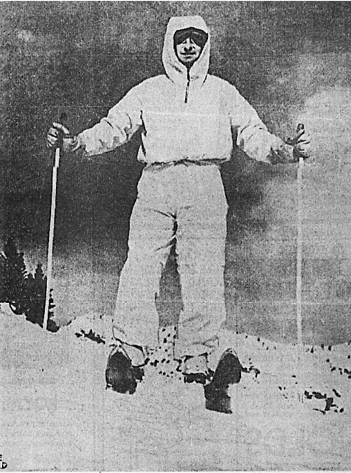
Captain Gorham leads the paraskiers
Eventually, the project was abandoned, and the troopers were spread out to the newly-forming parachute units. The Germans, however, were keenly aware of the threat of the para skiers, which caused them to divert combat forces to protect their logistics lines through the Alps.
Part 2 on Art Gorham: West Point and getting married
While at West Point, Art was known for pipe smoking and surviving academics. He played football for two years, and his near-weekly letters home to his parents often read like a sports report. One of his roommates at West Point, Donald R. Matheson, remembers, “Art one day effectively disrupted a complicated equestrian formation by departing from the back of his steed. With his foot caught in the stirrup, he was dragged dangerously until the instructor, in his wisdom, brought the formation to a halt. Surprisingly, neither horse nor rider was injured, merely subdued but philosophical. In his easy-going way, Art enjoyed, somewhat more than his roommates, periodic attempts at coaxing music from a trumpet, his greatest aspiration being to duplicate the recorded intricacies of ‘Carnival of Venice.’ Certain techniques persisted in avoiding his mastery. He was a devotee to jazz, and we were graciously entertained by his recordings, although a stern line was drawn by [roommate] Gordon Clarkson, who banned all music before breakfast.” Ultimately, Art graduated in the middle of his class and was commissioned as an Infantry officer.


Pictures of Lieutenant Gorham before graduation and In officer’s uniform following graduation
Marriage to Corrine Elizabeth Bennett
During the fall of his senior year at West Point, Art met Corrine Elizabeth Bennett when her cadet date from Wichita, Kansas, passed her off to him so he could dance with another lady at the traditional formal dance, called a “hop,” following a football game. Corrine was the head cheerleader of the Wichita University cheerleading squad. The Wichita football team played an exhibition game against the Army Team at West Point. The Secretary of the Army was from Wichita and had arranged the contest. Of course, the cheerleaders accompanied the team on their rail trip to West Point. Corinne was then a senior and president of the Pi Beta Phi sorority (then called the Sorosis Sorority), captain of the rifle team, and held titles in golf and tennis.
Following Art’s graduation from West Point, while awaiting transportation from Governor’s Island to the 30th Infantry at the Presidio in San Francisco, California, Art renewed his previous acquaintance with Corrine, who was “coincidentally” visiting her aunt who managed the Governors Island Officer’s Club. That rendezvous led to a wedding a year later on June 21, 1939, in Wichita, Kansas. The Wichita newspapers called it the social wedding of the year.


The young couple
Following their wedding the young couple were off to their first duty station together at the Presidio outside of San Francisco.
Introducing Arthur Fulbrook Gorham
Part One Introduction and the early years
On July 10, 2023, three generations of Arthur F. Gorham’s family will assemble at Ponte Dirillo, Sicily to pay homage to him and all of the brave warriors who liberated Sicily. This will be our fourth trip to Sicily during the past 20-plus years. May God bless him and all past and future warriors as we pray for peace but remain vigilant against the enemies of freedom.
On 12 July, 2023 The town of Bellevue, Ohio will pay homage to one of its heroes—Arthur F. Gorham. 12 July was chosen as it will be the 80th anniversary of LTC Gorham’s death while commanding the first battalion of the famed 505th Parachute Infantry Regiment and contributing significantly in the liberation of Sicily.
This story, remarks made in Sicily and descriptions and photos of the different events will be chronicled on this website for the several weeks.
To set the stage in the coming days I will share the story of Arthur F. Gorham.
The Early Years
Arthur Fulbrook Gorham was born on January 11, 1915, in Brooklyn, New York, to James Allison Gorham, Sr. and Louise Fox Gorham. His older brother was James Allison Gorham, Jr. His parents were second-generation Americans and were both of Scottish descent. The Gorham family moved to Bellevue, Ohio, when Art was three. Bellevue is a railroad town with a current population of about 8,000. When one visits the cemetery in Bellevue, one is struck by the number of graves with American flags on them. A particular portion of the cemetery is reserved for the deceased veterans so they can be honored and remembered. There is a ceremony conducted there every Memorial Day in May. The main street of Bellevue is lined with banners proudly displaying the pictures of some of these veterans. Patriotism seems to course through Bellevue’s veins.
Growing up, Art attended Ellis Elementary School and then Bellevue Central High School. During high school, he played in the band for four years, was secretary of the junior and senior classes, earned two varsity letters in football and two more in track, and served on the high school newspaper, the Blazer, for four years. Art was also a member of the National Honor Society. From speaking with family and his boyhood friends, I have learned that he acquired and exhibited many traits in his youth. For example, he was a terrible clarinet player but seemed to enjoy attempting to coax music from the device. He was also a poor equestrian, but not for lack of courage. He was soft-spoken but also demonstrated persistence. Indeed, his willingness to work hard and an unwillingness to settle for second-best were on display in his youth in Bellevue, his time as a cadet at West Point, and eventually, his time as one of the U.S. Army’s first paratroopers. These traits, and his exploits on the battlefield, would earn him a place in the school’s Hall of Honor over 70 years later.

Young Art Gorham in his Bellevue
Letter Sweater.
Art’s father ran a successful dry goods business in Bellevue. After graduating from high school in 1932, he had not received the sought-after appointment to West Point, so he attended Stanton Preparatory Academy in Cornwall, New York, and Miami University in Oxford, Ohio. Finally, in 1934, Art was admitted to West Point and joined the Class of 1938 at West Point.
A special day–June 21
84 years ago on June 21 1939 my mother Corrine Elizabeth Bennett and Arthur Fulbrook Gorham were wed in Wichita, KS. 54 years ago Susan Therese Higgins married me in Denver. CO. At the time we did not know my parents wedding day.
In the coming days i will be celebrating my father’s life and heroism. I will describe his life and the events leading up to his earning two Distinguished Service Crosses. There will conclude with ceremonies on 9 and 10 July in or near Gela Sicily and then a special commemoration in Bellevue, OH on 12 July (the date he was killed 80 years ago.
There will be 10-15 separate pieces when put together tell the whole story–stand by!
Conflict termination in Ukraine
In the past week or so the situation in Ukraine has escalated significantly:
- At the Munich Security Conference of elite national security experts there was a discussion of the end game in Ukraine, I am told by a participant. He went on to argue that there was no need for a public discussion of the conditions for ending the ongoing armed conflict. The discussion in Munich was significant, but of course it has not been made public.
- The president visited Ukraine and Poland where he made wide sweeping accusations against Vladimir Putin and pledged almost endless United States support for Ukraine. Biden declared in Poland that: “Ukraine will never be a victory for Russia, Appetites of the autocrat cannot be appeased. They must be opposed.”
- Relatedly, Leopard tanks started arriving in Ukraine.
- Russia made threatening mentions of resorting to the use of nuclear weapons and suspended adherence to the START Treaty. The Russians then did an ICBM test, which failed. (Talk about mixed messages.)[1]
- The Chinese continued to move closer and closer to Russia in their growing alliance.
The above being said the conclusions in my December article about Ukraine still stand.
The problem to reaching a conflict termination is either a lack of clearly defined definitions of acceptable end states by the participants to the conflict or totally mutually exclusive definitions of such end states. Actually, the situation could be both. In short, the war in Ukraine isn’t likely to end anytime soon. Both sides believe they can win on the battlefield, and thus little room exists for peace negotiations. This position was reinforced by President Biden and the Chairman of Joint Chiefs of Staff who said: ‘Russia has lost; they’ve lost strategically, operationally and tactically.’
The conflicting national objectives are personified by actions in the theater of operations. Ukraine is reportedly preparing offensives to regain the roughly 18% of its territory still occupied by Moscow, including the Crimea peninsula and parts of the eastern Donbas region that Mr. Putin seized in 2014. Russia’s goals are defined by its recent declaration that four Ukrainian regions, none of which it fully controls, are its own sovereign territory. Its current military objectives are to conquer those lands. However, Putin, in a speech last Tuesday, indicated that his aspirations remain much broader, referring to Russia’s “historical territories that are now called Ukraine.” There are also noises coming out of Russia of a “belt sanitaire”, which would include a part of Poland. There are further threats against Moldova. In short, the Russian objectives are based upon trying to create a neutral zone between it and the rest of Europe. The Russian psyche remains scared by the history of invasions from the west.
The promise of a post-war Ukraine joining NATO adds fire to this historical Russian fear.
The obvious totally irreconcilable differences do not create much optimism for a settlement any time in the future. However, during the next year the situation may change.
We are now a year into Europe’s bloodiest conflict since World War II, Ukraine’s own military industries have been shattered by Russian missile strikes, and its reserves of Soviet-vintage weapons are virtually exhausted. It is maintaining some of its strength thru captured Russian arms and munitions. Ukraine will quickly reach the point, if it has not already, where it can keep fighting only as long as Western assistance continues or ideally grows. Though public support for Ukraine has proven remarkably resilient, there is no guarantee that the mood won’t shift in the future, especially if the predicted global economic downturn has any duration. Thus, the west has leverage on Ukraine[2]. A return to the current administration’s previous gradualist approach might be the signal to Ukraine that a new tact is needed. This would be evidenced by a continual delay in the delivery of the promised M-1A1 tanks and continued denial of the desired F-16 fighters.
To reach such a return to the gradualism of survival versus battlefield victories the pro-war retired generals will need to have concluded that the war is no longer winnable. Retired LTG Ben Hodges, a former commander of the U.S. Army in Europe, has been quoted as saying: “It has taken the Pentagon a long time to come to the realization that Ukraine can win, and will win, especially if we give them what they need. There has been all too much defeatist hand-wringing.” General Hodge’s perspective is shared by numerous active and retired general officers. They represent a significant domestic lobby for increased materialistic support for Ukraine. Conversely, there is a growing number of pundits and politicians who argue that the almost $200 billion dollars given to Ukraine could go a long way to alleviating many domestic problems.
China’s recent stand of sliding towards Russia while not wanting to anger its European markets is an interesting political dance. Thus far China has not provided lethal aid to Russia but recent pronouncements by Secretary of State Blinken suggests that it is strongly considering such an action. Thus far it hasn’t. Aside from statements from China’s leader Xi Jinping that nuclear war must be avoided—the sort of truism few would argue with—China has offered no criticism of Russia’s actions. China and Russia have scheduled a Spring summit. One can fear what might result from that. Interestingly, Zalenski has said that he would like to meet with Xi Jinping.
In its attempt to assuage the western Europeans, while not angering Putin, the Chinese recently released a paper, which appealed to the European desire to return to cheap Russian energy, The12-point document on Ukraine called for a cease-fire and peace talks. It included demands, such as not strengthening military blocs or using unilateral sanctions, that clearly catered to both Russia’s and China’s interests.
Another view is that China’s leadership is concerned that a prolonged conflict could leave its strategic partner severely crippled. The increased sanctions that the west is imposing on Russia could both adversely affect China’s sales to Russia but could also be applied to China itself. China fully realizes that currently the US is dependent upon Chinese goods. But that even this administration might eventually see the folly in that position.
Given all of the swiftly changing geo-political currents and military realities around the conflict in Ukraine how does it end?
Militarily, excluding the use of nuclear weapons, there are really only three options:
- Ukraine wins by expelling the Russians from all Ukrainian territory either including or excluding Crimea
- A decisive Russian victory, resulting in Ukraine becoming an integral part of the Russian Federation
- An extension of the current standoff with both sides relatively exhausted and a subsequent ceasefire and other mutual accommodations.
In the first scenario, following a much faster supply/resupply of Ukrainian forces there would be a series of crucial battles this year in which Ukraine’s military forces impose a succession of decisive defeats on the Russians, forcing them to retreat back over the pre-2014 Ukrainian border into Russian territory. Such victories would be more decisive if Russian troop defections increased. Will Russia give up its possession of Crimea at any cost? Probably not! However, it might be a practical proposition to envisage Ukraine evicting Russian troops from Donetsk, Lugansk, Zaporizhzhia and Kherson.
The second scenario involves a decisive military defeat of the Ukrainian Armed Forces by Russia. Such a defeat would most likely include the bombing of Kyiv. That would result in the complete crushing of the Ukrainian language, people, religion and culture. A victorious Russia might then be encouraged to chance its luck elsewhere and threaten the Baltic countries, Poland and other states on its periphery—such as Moldova and Kazakhstan—with forced incorporation into the Russian motherland. The aim of the Russian leadership since the end of the cold war has been to reestablish a cordon sanitaire of buffer, which effectively created defense in depth for Russia and put 1,000 kilometers between it and the nearest NATO borders. The challenge for Washington would be to demonstrate that any such Russian attack on Estonia, Latvia, Lithuania, Poland or any other NATO country would automatically provoke prompt US global strikes on Russia, including Moscow. That could well take us all to a larger World War III. Failure to defend Estonia, Latvia, Lithuania, Poland and the rest of NATO would be the death of NATO.
The final scenario involves eventual negotiations between the two sides resulting in a durable truce and international safeguards against any repetition of military attacks across agreed international borders. Coupled with some from of cease fire and the creation of a demilitarized zone along the extent of the border to include most of Crimea would be the requirement for some sort of international agreement imposed to prevent Moscow from rebuilding its military forces and having another go at it. Ukraine would have to renounce its goal of joining NATO, while NATO would most likely need to provide some territorial guarantees to the new boundaries.
The reality is that a negotiated outcome is unlikely in the immediate future. It is more likely that the intensive war will continue with no resolution in sight. The outcome of this prolonged war of attrition or protracted military stalemate would depend on which side has the most durable military industrial base (in the case of Russia) or guaranteed external military resupplies (in the case of Ukraine). It is at this point that the roles of China and Iran must be considered.
A prolonged stalemate that would include increasing human and resource costs could eventually result in some form of negotiated agreement. However, since Ukraine is unwilling to cease to exist the key is an eventual realization by Russia that the gains are not worth the costs. Russia must come to realize that it will emerge from this stalemate as a reduced national power—a second class power like the individual NATO countries—with nuclear weapons. In short, it must decide to pack its bags and wait for another day.
After all of the above is said and considered the conflict termination is dependent on Russia realizing (sooner rather than later being ideal) that there is no possible positive outcome from the conflict. This would substantiate the Clausewitizian dictum that, “once the expenditure of effort exceeds the value of the political object, the object must be renounced, and peace must follow.” The political ramifications of this result in Russia and Europe are a subject for another analysis.
It is unfortunate that the only foreseeable termination of the conflict will entail such enormous loss of life and resources. It will also usher in a changed world order.[3]
[1] The subject of Russian use of nuclear weapons is deferred to a subsequent article while noting that such use would change the whole nature of the conflict. The threat must presently be seen only as an attempt by Russia to find more leverage.
[2] UK, French, and German officials are reportedly preparing a NATO-Ukraine pact that falls far short of the protections Ukraine would receive from NATO membership and appears to reflect a desire to press Ukraine to accept a negotiated settlement on unfavorable terms. The Wall Street Journal reported that the pact will provide advanced military equipment, arms, and ammunition to Ukraine, but not Article V protection or a commitment to station NATO forces in Ukraine—falling short of Ukraine’s aspirations for full NATO membership. The pact aims to provision Ukraine so that Ukrainian forces can conduct a counteroffensive that brings Russia to the negotiating table and deter any future Russian aggression. The officials reportedly expressed reservations about the West’s ability to sustain a prolonged war effort, the high casualty count that Ukraine would sustain in such a prolonged war, and Ukrainian forces’ ability to completely recapture long-occupied territories like Crimea.
[3] The exact composition of this new world order is a subject for future analysis. However, if China remains above the fray, it will most likely emerge as the dominate global power. It would not have expended resources in the battle while Russia, Europe and the US will have.
Articles about Khe Sanh
The past month or so we presented a entire series of articles on the events leading up to the siege of the Khe Sanh Combat Base (KSCB) and its subsequent conclusion. This summary provided a road map for those who want to catch up on what happened 55 years ago starting just before January 21, 1968.
I post these articles so that readers can appreciate the gallantry of the Bru Montagnards, the Vietnamese soldiers, the Marines of CAC O, the other members of Advisory Team 4, CPT War Britt the FAC and all of the others that were involved in the village fight specifically, but also those soldiers, airmen and Marines who were all involved in the Battle of Khe Sanh. My hope is that the glaring mistakes that were made in Khe Sanh will not be repeated and that tacticians and strategists of the future will take away some valuable lessons.
The articles included the following:
Was America Duped at Khe Sanh—debunks an article in the New York Times about North Vietnamese strategy leading up to Khe Sanh
General Westmoreland and the Vietnam War Strategy—continues the discussion of the false items in the previously mentioned New York Times article. It presents the dueling strategies of the two sides.
Limited War and Rules of Engagement—presents a discussion of the problems with limited war concepts and how they related to Rules of Engagement.
Khe Sanh—the intelligence build up—explains the origins of the title Expendable Warriors.
Command and Control in the Khe Sanh Area of Operations (AO)—explains the quagmire that was the local command and control situation. Lack of unity of command lead to a lack of unity of effort.
1968 Advisory Team 4 Newsletter—how the battle around the village was originally explained in a newsletter published by Advisory Team 4 headquarters in Quang Tri.
The village fight 2—further explains what happened during the defense of the District Headquarters
Air Support for Khe Sanh Village—explains the various forms of air support that were used to support the defenders of the District Headquarters and how they were coordinated for.
The Battle of Khe Sanh Village is Over—the Advisory Team the district forces withdraw after the Marines are withdrawn and further artillery support is denied.
False Quiet—sets the stage for the attack on Lang Vei and describes life on the combat base.
The noose is tightened—gives an overview of the fall of the Lang Vei Special Forces camp.
The Battle is won and the war was lost—describes the ending to the 77 day agony of Khe Sanh and the moment in history when the war was lost.
Each of these articles can be found on https://brucebgclarke.com/
 Bruce B.G. Clarke